Herbert and Florence Irving Cell Research Program
Neuroscience Meets Cancer
Established as part of the transformative, $700 million bequest in 2017 from the late Herbert and Florence Irving to Columbia University and NewYork-Presbyterian, the Herbert and Florence Irving Cell Research Program promises to advance cancer research by bridging neuroscience and cellular development.
The Irving Program leverages the Zuckerman Institute's strength in the molecular and cellular biology of neurons to catalyze the investigation of fundamental scientific questions with strong implications for cancer. What are the biological mechanisms governing the life and death of different cell types? When does the nervous system function as a protective defense mechanism against tumors, and when is it co-opted to promote cancer growth? Knowledge about these questions is currently limited, despite being essential for understanding, treating and eventually curing diseases that dramatically increase in prevalence with age.
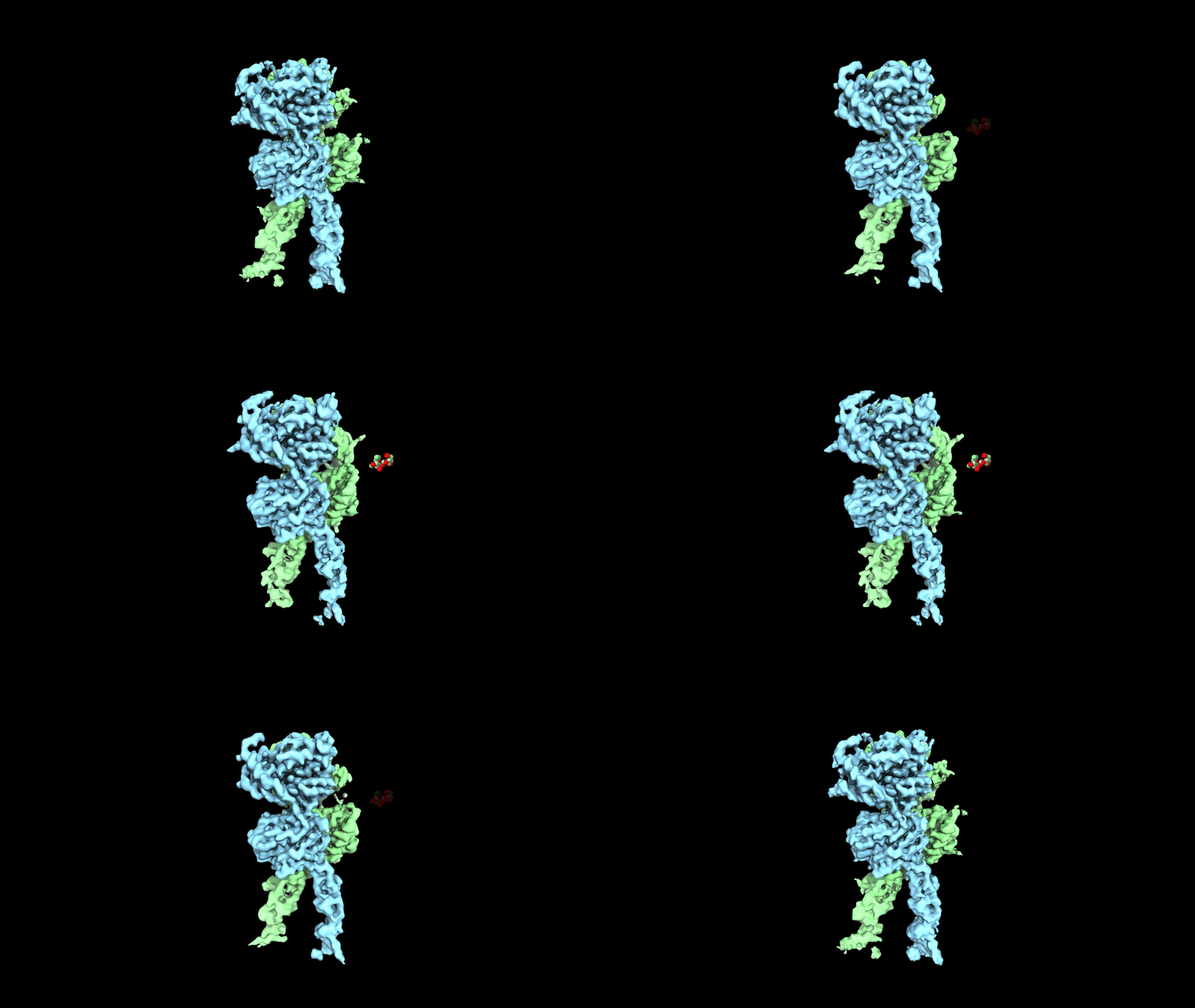
Central to the Irving Program’s pursuit of an answer to these basic yet perplexing biological questions are the Herbert and Florence Irving Professorships, awarded to scientists engaged in highly collaborative research programs with strong implications for cancer biology, in particular for tumors of the brain and the nervous system. Funds dedicated to the Irving Program also support early-career scientists, equipment and a cryo-electron microscope (CryoEM), which images proteins within cells at molecular resolution to advance our understanding of cancer, neurodegeneration and even viruses, such as COVID-19.
FEATURED PROJECTS
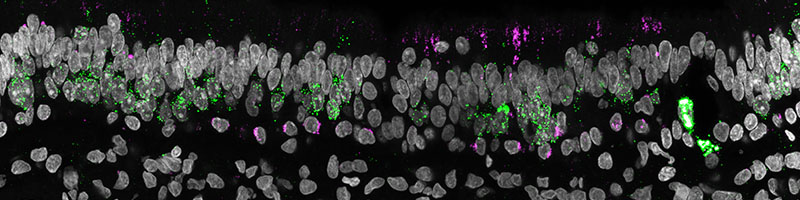
Olfactory epithelium from a COVID-19 patient showing neurons (green) and infected cells (purple) (Lomvardas lab).
The Lomvardas lab explores how individual olfactory neurons specialize for a specific odor molecule. This, the researchers discovered, requires the sticking together of chromosomes inside the cell, a process that locks in a single odorant receptor for the life of the cell. Many tumor cells also possess such connections between chromosomes, which can lead to cellular instability and seem to be shared across patients and cancer types. The Irving Program allows this team to pursue the idea that these cancer-association translations arise through the same exquisite molecular machinery being studied in neurons.
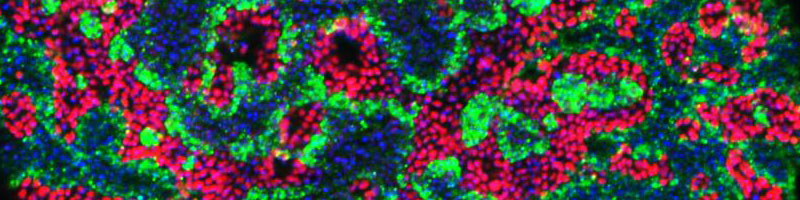
Whorls of cells trying to form body segments in a fly embryo (Struhl lab).
The Struhl lab studies molecules that organize the growth of biological tissues: specifically, molecules from the Wingless/Int (Wnt) and Hedgehog (Hh) superfamilies, found across the animal kingdom. Using fruit flies, the researchers ask how these molecules spread through tissues, how they send signals that control cell behaviors and how their activities govern when, where and how cells gain mass and proliferate during normal development. Determining the basic mechanisms by which these molecules control normal growth is an essential step toward diagnosing and treating the abnormal growth that is the hallmark of human malignancies such as cancer.
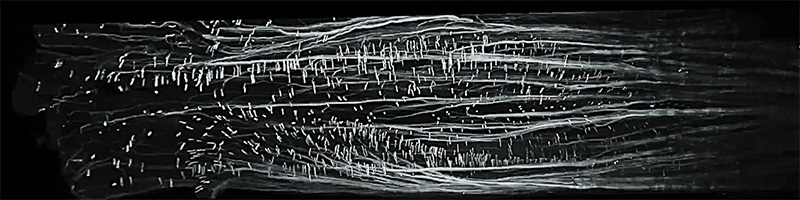
Mouse olfactory epithelium in a cleared brain (Marlin lab).
The Marlin lab studies how an experience in one generation can shape the biology of the next. Their work asks how a learned association is transmitted, and how offspring can be shaped by the experiences of a parents, not through teaching but through their inherited germline. This raises questions at the center of the Irving Program's mission: How is a decision about a cell's identity and fate established, transmitted epigenetically through the germline and recapitulated in an entirely new organism, all without any change to the DNA itself? How do cancer cells acquire and maintain aberrant gene expression, and what are the susceptibilities associated with these changes?