Roundworms, or nematodes, are by far the most abundant creatures on Earth, accounting for an estimated 80 percent of all animals on land alone. Famed naturalist E.O. Wilson noted, "If all solid materials except nematode worms were to be eliminated, you could still see the ghostly outline of most of [the planet] in nematode worms."
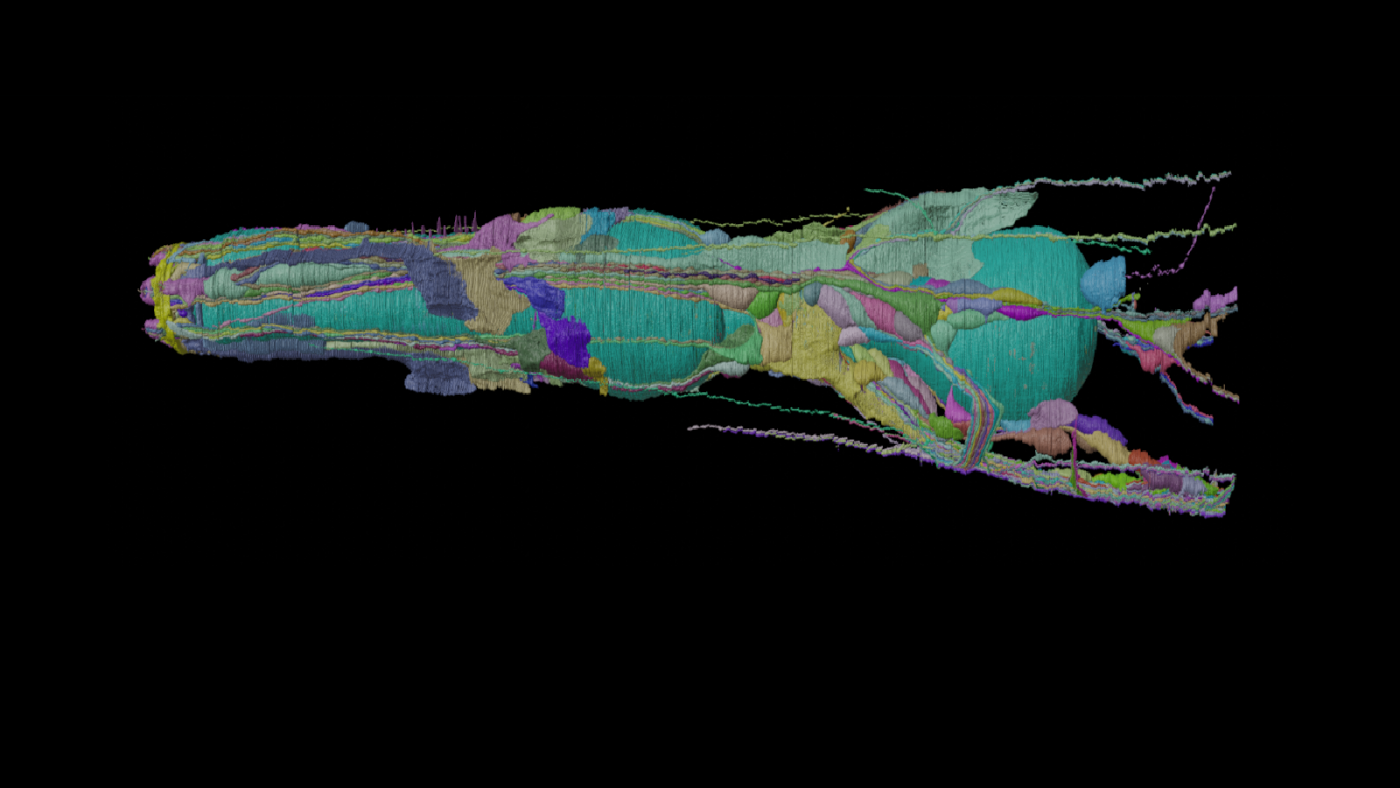
Shown here are all 180 neurites in the brain of one nematode species, Pristionchus pacificus, charted in exquisite detail with the help of serial section electron microscopy. A new Science study compares this nematode to its much-studied relative Caenorhabditis elegans, which was the first animal to have its nervous system completely mapped. Because these worms have a surprising amount in common with us—having symmetrical left and right halves, for instance, and sharing a great deal of our molecular machinery—they could help us understand the evolution of our own brain.
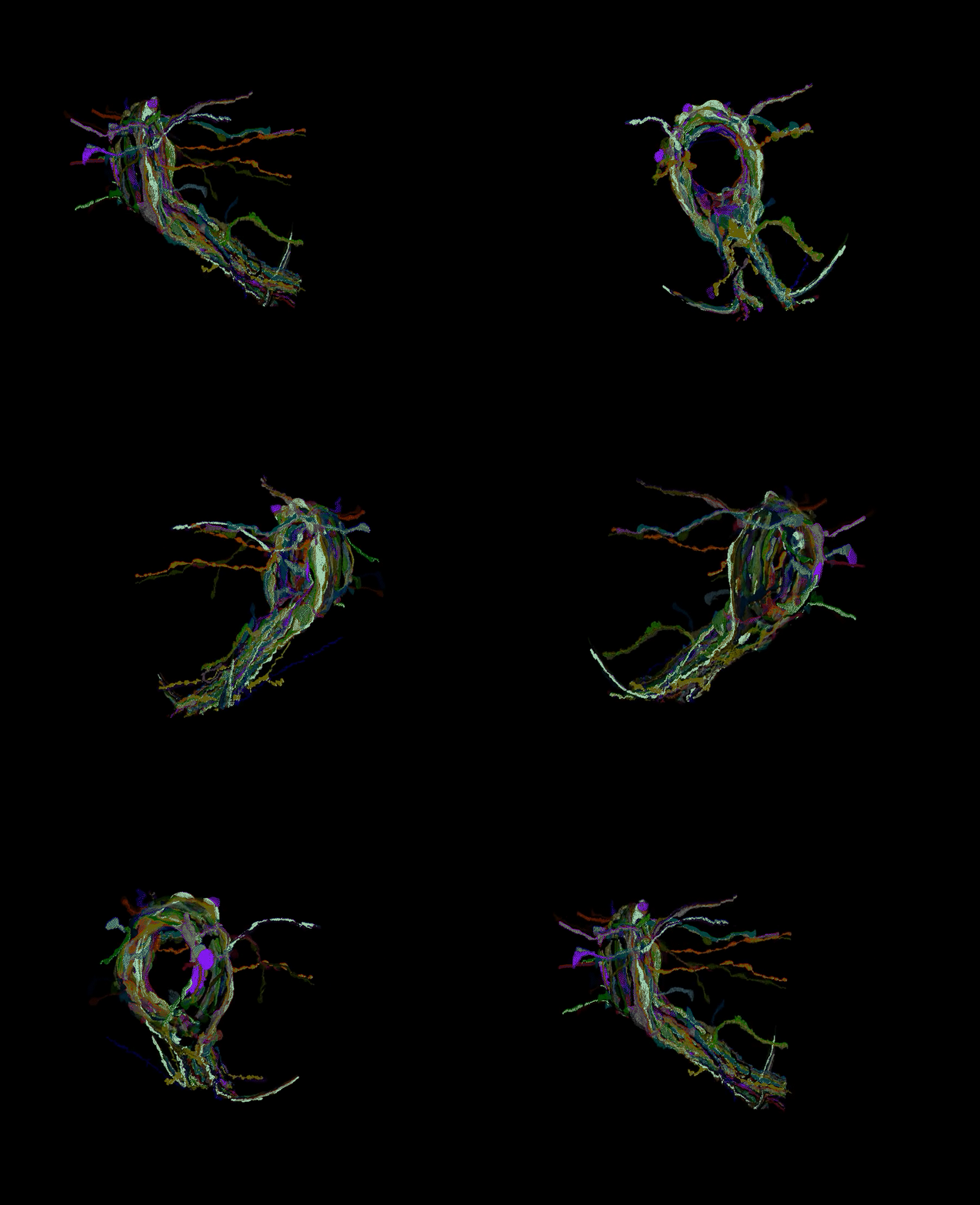
Rotating view of the brain of the roundworm P. pacificus.
(Credit: Steven Cook / Columbia’s Zuckerman Institute).
"If we want to understand what goes wrong in neurological diseases like Alzheimer's or Parkinson's, we first need to understand what 'normal' looks like across different levels of complexity," said Steven J. Cook, PhD, co-corresponding author of the study, who conducted this research at Columbia University. "By comparing these simpler nervous systems, we're developing the computational tools and fundamental knowledge for studying the billions of neurons in the human brain."
P. pacificus and C. elegans diverged evolutionarily from their common ancestor at least 100 million years ago, roughly the same amount of time that separates mice and humans. But their nervous systems remained similar enough to allow Cook and his colleagues to compare each cell, one-to-one.
"It's fascinating to appreciate how many architectural features were conserved over this long time span of evolution," said Oliver Hobert, PhD, a professor of biological sciences, biochemistry and molecular biophysics at Columbia University, and co-corresponding author of the study.
Despite these similarities, the research revealed profound differences in the numbers, positions, and shapes of neurons, as well as in their connections. These changes may have evolved due to the distinct predatory behavior that P. pacificus displays toward other nematodes. Its neural architecture has been shaped by alterations in the times and places cells are programmed to die off during the animal’s development when young.
"I'm a gardener at home. I prune and remove my plants rather than trying to grow the precise number and size in the spring," said Dr. Cook, currently at the Allen Institute for Brain Science in Seattle. "The brain isn't so different.”