NEW YORK, NY — Sean McFadden teaches 12th grade climate and environmental science—a class that might not sound like it has much to do with neuroscience. But thanks to recent guidance at Columbia’s Zuckerman Institute, McFadden has discovered creative ways to get his students wondering about the brain. In a unit on noise pollution, for example, he asked students to observe how their brains performed when they tried to memorize words in a quiet setting and then a loud one.
“It helped them see that not all studying is equal, and it helped illustrate issues of environmental justice, to think about who has to live with the effects of noise pollution,” McFadden said, who teaches at Eagle Academy for Young Men II in Brooklyn. "The students started off a little skeptical, but for them to quickly see a real effect, to have that pretty instant gratification, led to a really strong response."
McFadden is one of dozens of New York City high school teachers bringing neuroscience to classrooms with the help of the Stavros Niarchos Foundation Teacher-Scholar Program, hosted at Columbia’s Zuckerman Institute since 2015. Its paid fellowships help educators both learn about cutting-edge brain research and create educational materials.
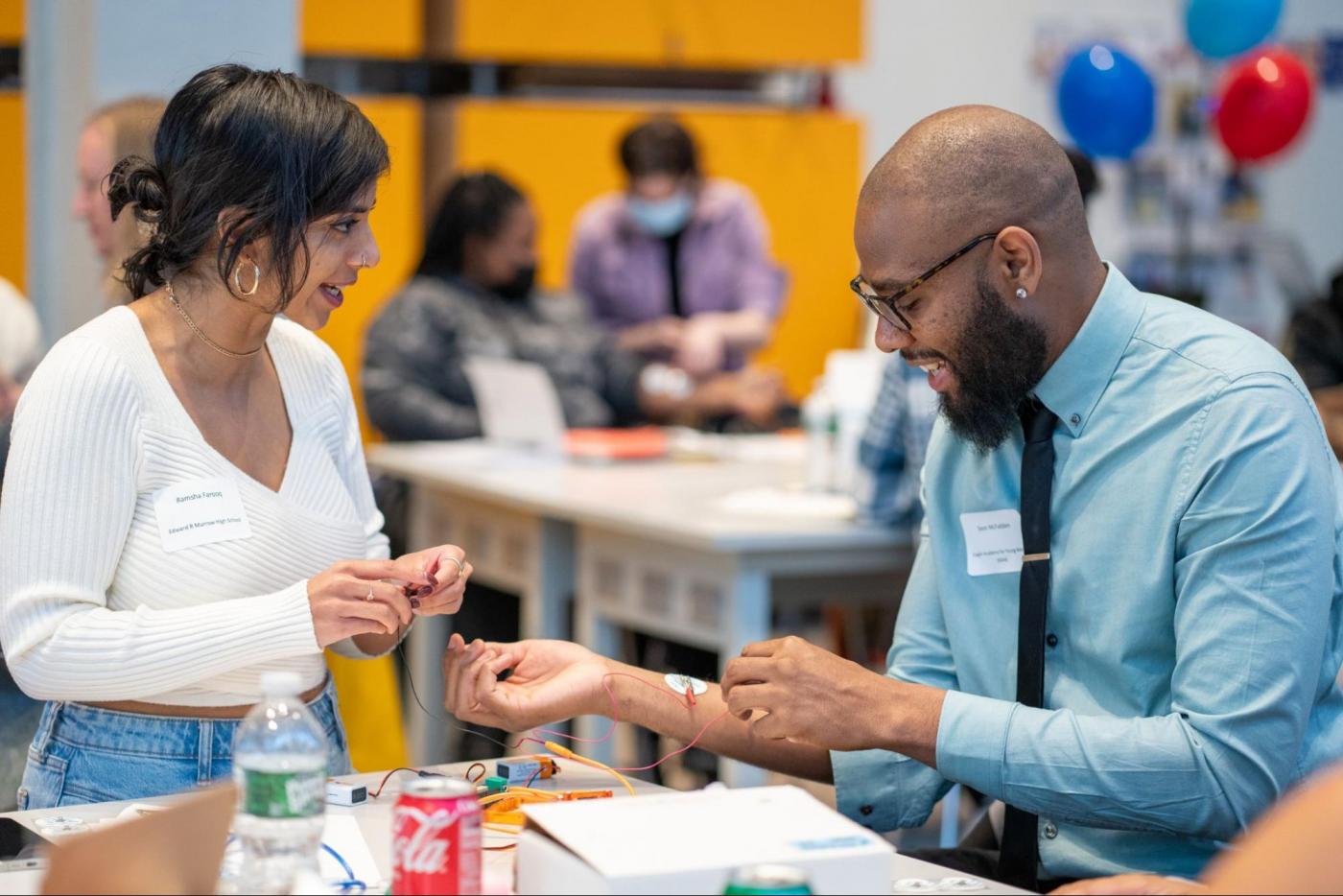
Ten years in, the program continues to excite a passionate loyalty in teachers. “I’m continually learning new information and new approaches to studying the brain,” said Ramsha Farooq, who teaches the science of emotions to grades 10 to 12 at Edward R. Murrow High School in Brooklyn and has been in the program for two years. “This not only pushes me to ask questions, just like my students, but also encourages me to adjust and improve my own curriculum and practices.”

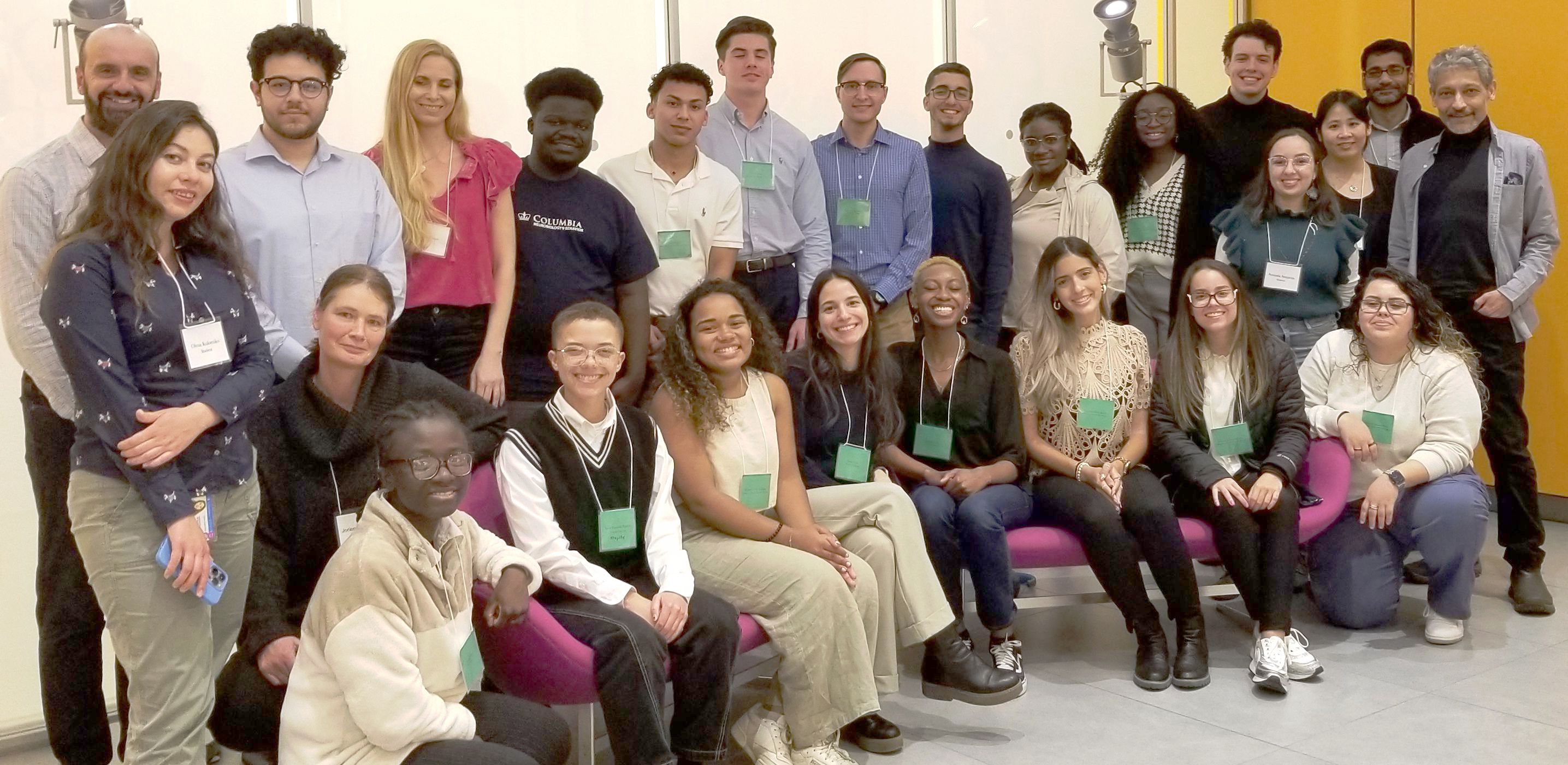
(Left to right) Maia Gumnit, Sean McFadden, Deborah Reich, Andrew Anderson and Gwendolyn Salas discuss neuroscience in the classroom. (Photo by Sirin Samman)
Both teachers and their students attend research talks given by Columbia researchers, as part of the Stavros Niarchos Foundation Brain Insight Lectures for the public. There, educators in the program from public, independent and parochial schools learn about how neuroscience intersects with everyday life. These events are freely open to both a public and virtual audience, and all the videos from the series are available in a publicly accessible archive.
“The brain is very engaging for students, even for those that may not always be interested in science, because there's so much still to learn about it,” said Deborah Reich, who teaches biology to 9th graders at World View High School in the Bronx and has been in the program for six years.
These lectures include discussions about the science behind adolescent brain development, the use of music and entertainment to teach children to identify warning signs of stroke and the promise that neuroscience holds for reducing test anxiety in students.
“We get to not only listen to the scientists and see their research, we get to talk to them as well at the end of the lecture and ask questions to help us connect it with education,” said Alejandro Mundo, who teaches earth science at Kingsbridge International High School in the Bronx and has been in the program for three years. “We bring our students, who bring their questions. The curiosity this sparks can lead to conversations and learning experiences they won't forget.”
In addition, neuroscience PhDs on Zuckerman’s public programs team lead seminars for the teachers where they dig into the research from the lectures and work in small groups to devise creative ways to bring it to students.
“Because the program has teachers with different backgrounds and schools and subjects,” said McFadden, “you're getting a plethora of ideas, some really high-quality brainstorming."
Critical thinking, problem solving, systematically gathering evidence before making conclusions, all these are very beneficial to everyone, regardless of if they continue in STEM,
Even if students do not go on to become scientists, they are learning life-long skills. “Critical thinking, problem solving, systematically gathering evidence before making conclusions, all these are very beneficial to everyone, regardless of if they continue in STEM,” Mundo said.
Ultimately, the impact of the program reaches far beyond its teachers' classrooms, given how the program's BrainSTEM Resources, which include lesson plans, are free online.
"The lesson plans we create, which are vetted for scientific accuracy by neuroscientists, are viewed outside the city, outside the state and even outside the country," said Mundo, who has served as a curriculum developer for the program. "The resources we devise, such as a lesson about how the brain interprets sounds that we've just finished, are straightforward. Any teacher can use them."
Moving forward, “we're excited to continue bringing current neuroscience research out of the lab and into the classroom, while supporting our community of local teachers,” said Maia Gumnit, PhD, a senior public programs manager at Zuckerman. “By expanding our library of free classroom resources, we hope to empower educators everywhere to engage their students with real-time discoveries about the brain.