NEW YORK, NY — How do we create mental maps of the world? By having mice explore mazes in virtual reality, scientists at Columbia's Zuckerman Institute have now shed light on how the brain recognizes familiar and novel environments, The findings were published online in the journal Neuron on July 8.
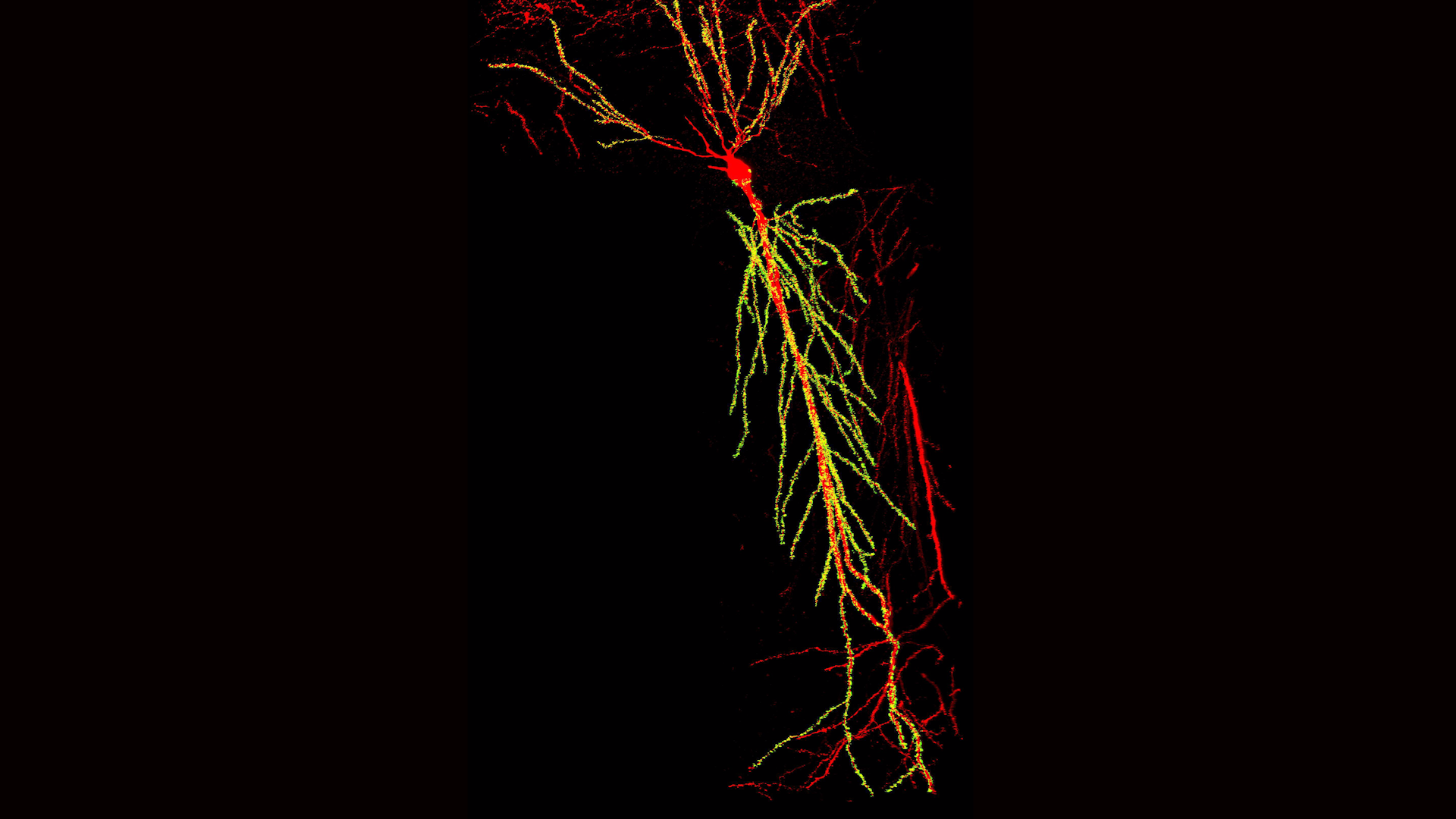
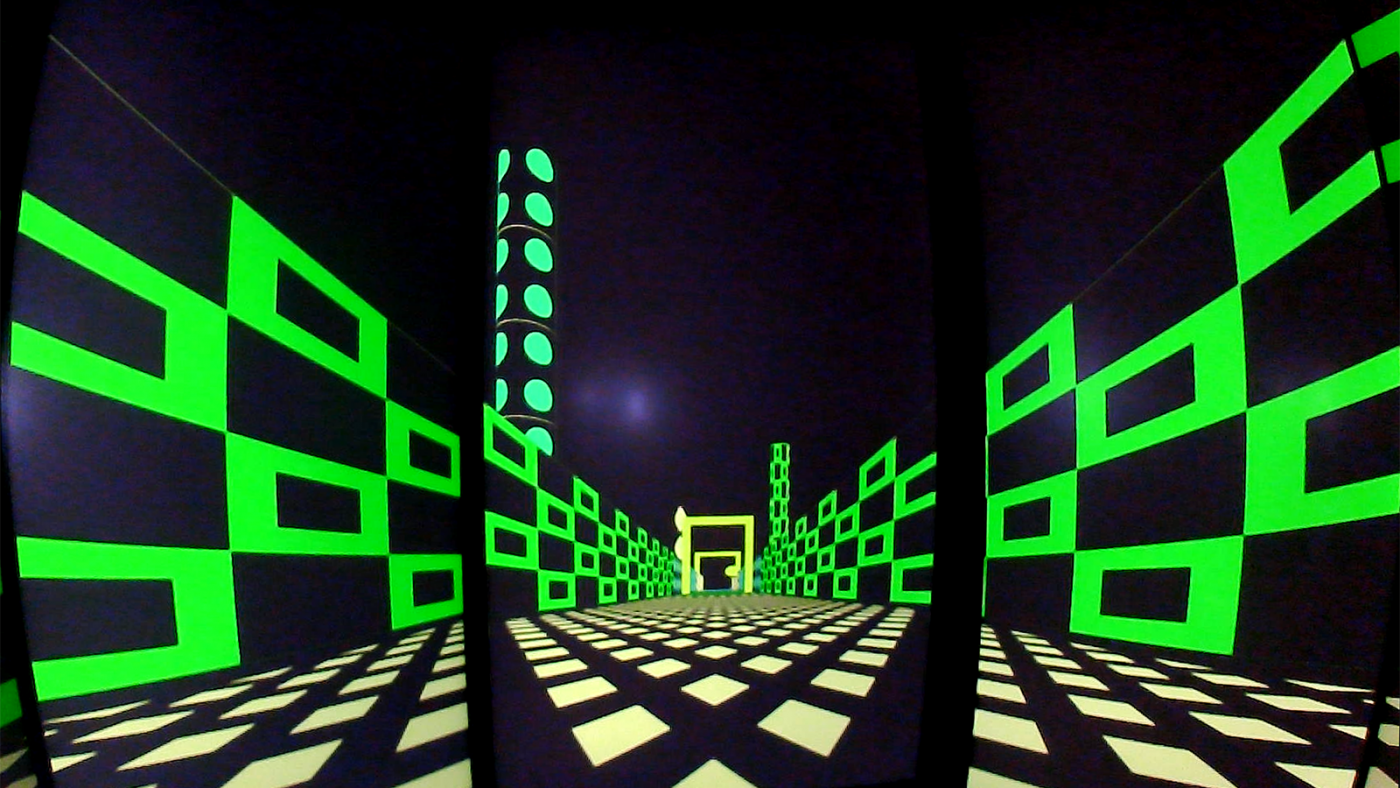
Mice in the new study navigated virtual hallways and discovered places that delivered sips of real water. As the rodents explored, scientists monitored the hippocampus, a seahorse-shaped region of the brain central to memory. The researchers focused on the hippocampal region known as CA3, which helps retrieve full memories from partial cues, as when someone remembers a complete song from just a fragment of a tune.
“We wanted to understand how differences in local circuit architecture give rise to different forms of memory computation,” said study co-lead author Eunji Kong, PhD, a postdoctoral research scientist at Columbia's Zuckerman Institute.
Previous research showed that in one part of the CA3 region of the hippocampus, neurons are sparsely connected with each other, while at the other side of the CA3 area, neurons are densely connected. In this study, the scientists found sparsely connected CA3 neurons were associated with older, more familiar neural maps the mice had mentally constructed of places they previously visited. In contrast, the densely connected CA3 neurons were linked with newer, more recent neural maps of areas the mice were still learning to recognize.
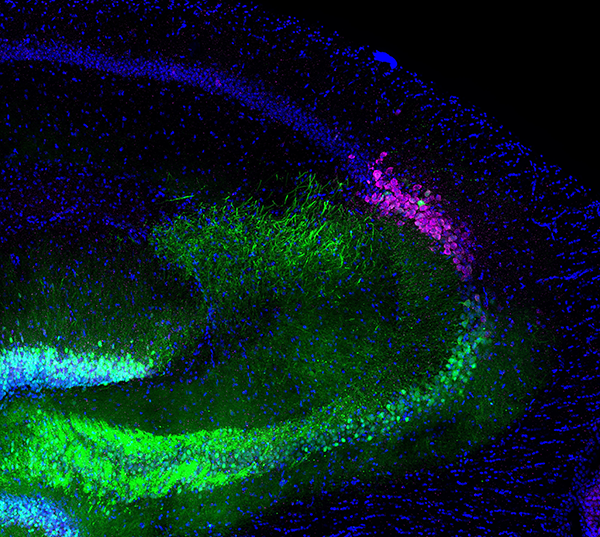
In the mouse hippocampus, distal CA3 neurons (green, upper right) are densely connected together, while proximal CA3 neurons (green, lower left) are sparsely connected together (Eunji Kong / Losonczy lab / Columbia’s Zuckerman Institute).
"This reveals new details on a very fine level about the brain computations that drive memory in our daily lives," Dr. Kong said.
Study co-lead author Erfan Zabeh, a doctoral student in the Gottlieb lab at the Zuckerman Institute, helped devise AI models with different densities of connections between artificial neurons. When exposed to virtual reality mazes, AI models with sparse and dense levels of connectivity performed better with recognizing familiar and novel environments, respectively, just as the mice did.
The predictions from the AI models guided the researchers to genetically shut down neural signals within the hippocampus. This provided evidence that the architecture of circuits in that brain region shapes neural representations of space and context.
These findings suggest that denser levels of neural connectivity may help recognize novel places by better processing more kinds of details about those areas, Dr. Kong said. In contrast, sparser levels of connectivity may help map relatively simple places in a stable manner, or consolidate memories about familiar places, said study co-author Darcy Peterka, PhD, a senior scientist and principal investigator at the Zuckerman Institute.
"This work has laid the foundation for our ongoing research into how individual synapses within the hippocampus give rise to stable yet flexible memory computation," Drs. Kong and Zabeh said. "By combining computational modeling with imaging, we hope to uncover the synaptic mechanisms that link circuit architecture to memory."
"These findings were made possible by the environment here at the Zuckerman Institute, where experimentalists and theorists are so closely linked to help drive discovery," added Dr. Peterka, who is also director of team science and scientific director of cellular imaging. “This collaboration helps us better understand the brain circuitry underlying memory, which is important for understanding how memory can get disrupted, whether in cognitive impairment as people get older or any neurological disease that affects memory and the hippocampus.”
###
The paper, “Recurrent connectivity shapes spatial coding in hippocampal CA3 regions,” appeared online in Neuron July 8.
The full list of authors includes Eunji Kong, Erfan Zabeh, Zhenrui Liao, Tiberiu S. Mihaila, Caroline Wilson, Charan Santhirasegaran, Darcy S. Peterka, Tristan Geiller and Attila Losonczy.
This work was supported by an overseas postdoctoral fellowship (RS-2024-00406980) from the National Research Foundation of Korea, an R00MH129565 from the National Institute of Mental Health (NIMH), the NIMH (R01MH124047 and R01MH124867); the National Institute on Aging (NIA) RF1AG080818; the National Institute of Neurological Disorders and Stroke (NINDS) Brain Initiative U01NS115530; and NINDS R01NS121106, NINDS R01NS131728, and NINDS Brain Initiative R01NS133381.
The authors report no competing interests.