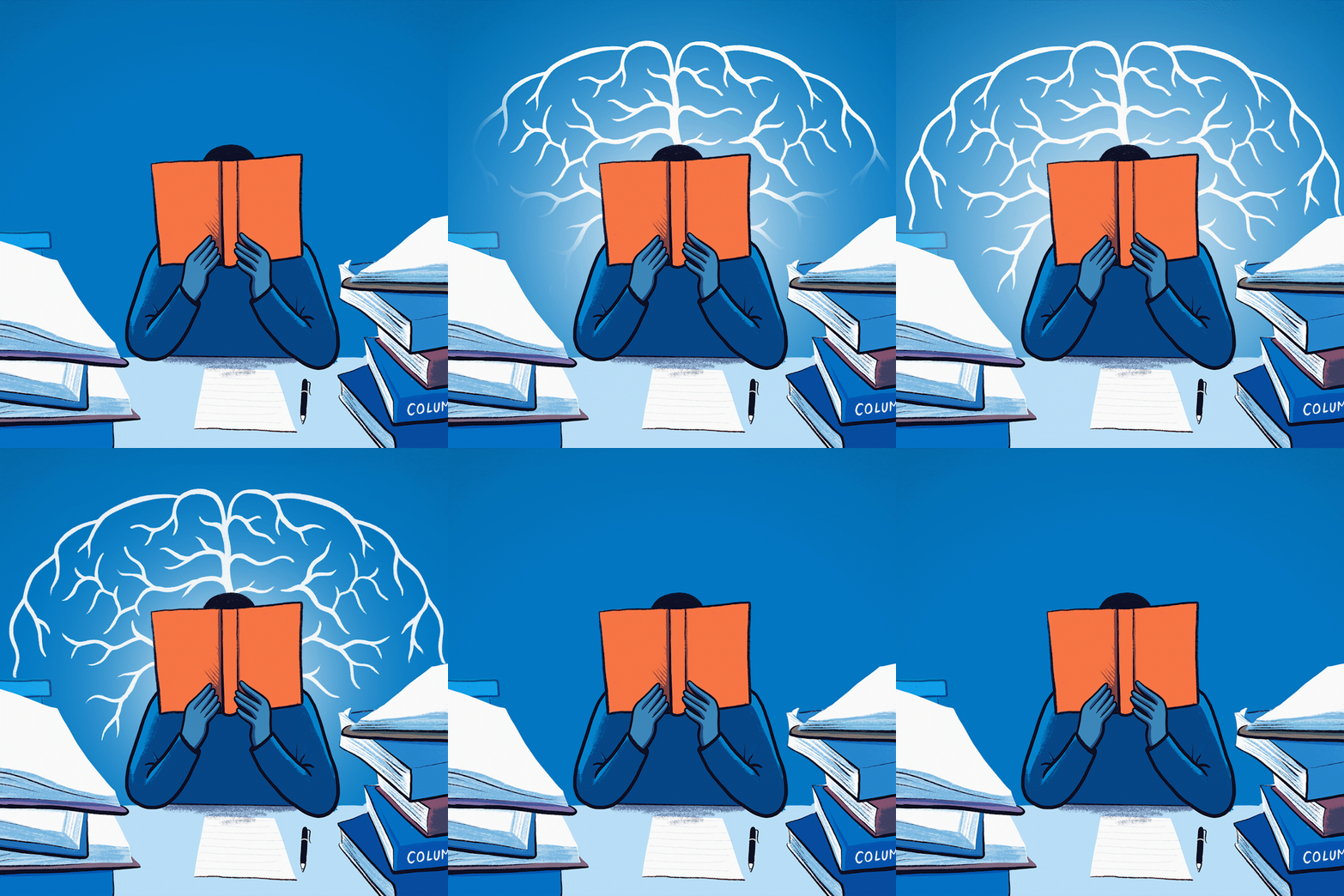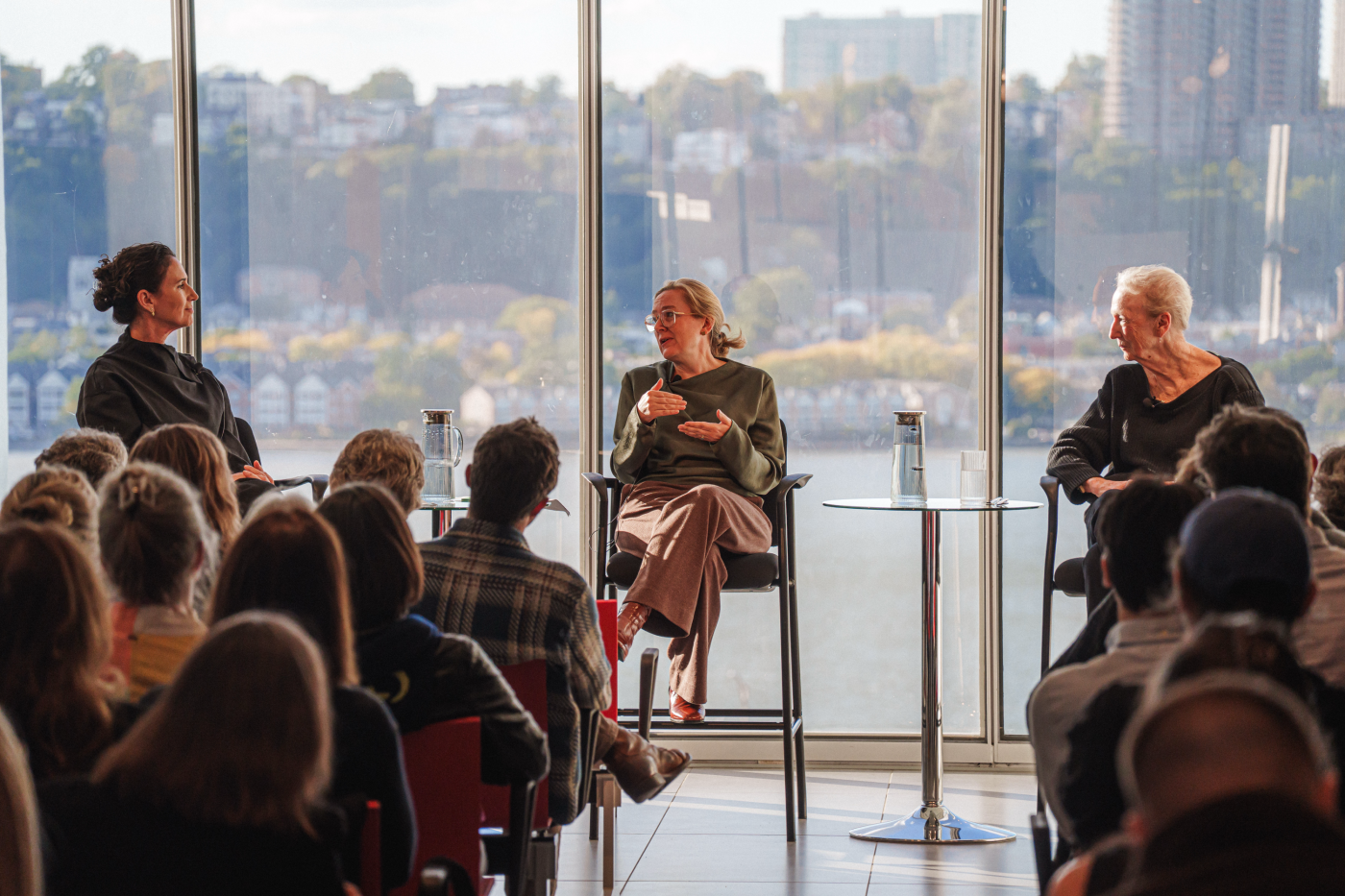
NEW YORK, NY — A seemingly unlikely trio gathered at Columbia’s Zuckerman Institute last month for a conversation that explored memory from an unusual vantage point bridging science and the arts.
The event marked the end of a year author Sarah Ruhl spent at the institute exploring mind, brain and behavior as an Alan Kanzer Writer-in-Residence. Ruhl, a MacArthur “genius grant”-winning playwright, was joined for the discussion by longtime collaborator Kathy Chalfant, an Obie-winning and Tony-nominated actress, and Ruhl’s host for her journey through science, world-leading researcher Daphna Shohamy, PhD, the Zuckerman Institute's director and Kavli Professor of Brain Science.
"I am a person who's obsessed with the past and with memory," Ruhl said. Memory research at the Zuckerman Institute that struck her as especially interesting was the work of Dmitriy Aronov, PhD, who studies black-capped chickadees. These songbirds can recall the locations of thousands of morsels of food, Dr. Shohamy explained at the event.
Following this through-line between memory and spatial location, Ruhl talked about learning from Dr. Shohamy that memories get bundled with the mind's experience of being in physical places.
"Is that why it's so hard to remember people when you meet them on Zoom?" Ruhl wondered. "It's the same principle with Kindle. When I read books on my Kindle, they pass through me like spicy food through a spastic colon. I can't remember where I was when I read them, but a physical book someone has given me, if I read it, say under a tree, I remember the time, the place, the circumstances — it all comes back."
Ruhl discussed how much the physicality of books means to her, and explored a connection between memory and reorganizing her library. "Rearranging my books could be like rearranging my memories," she said. "I could create little paths between my Catherine Mansfield era and my early 20s and my current self."
All in all, actors "have so much to teach scientists about the brain and how it processes memory," Ruhl said. Why? Because in a digital age where our smartphones and computers help remember everything for us, "actors will be some of the few practitioners of memory."
Attendees saw this in action as Chalfant read a monologue from Ruhl's 2016 play, "For Peter Pan on her 70th Birthday,” which Ruhl had written in honor of her own mother’s birthday. Although Chalfant last performed the material 10 years ago, Ruhl marveled that "the inflection and the emotional leaps between thoughts were exactly the same.”
For Chalfant, memorizing the emotional aspects of a text was as important as memorizing the actual words, if not more so. “The state that I'm always trying to get to after learning a part is, when I open my mouth, the words will come out, and it will have the illusion of them being spoken for the first time,” Chalfant said.
To help actors memorize how to perform emotions as if they experienced them spontaneously, Ruhl recalled that director Konstantin Stanislavski would ask actors to not memorize their lines before rehearsal, “because he wanted to create that freshness. He would even put a piece of paper over the next line as you were reading, so that you couldn't anticipate what was going to be said, and you couldn't know what was said. It is a kind of magic trick.”
The emotional weight that Chalfant learned to associate with performances could have unexpected consequences. She talked about how she now felt it was impossible for her to embody one particular role after discovering the core premise of a work was fiction. Once she performed as the writer Joan Didion in a play adapted from Didion’s autobiographical memoir, "The Year of Magical Thinking," in which Didion dealt with the death of her husband and daughter. The premise of the memoir is that these deaths came as a surprise to Didion, but later Didion's nephew Griffin Dunne published notes from Didion's psychiatric sessions, where it was revealed she had actually known about her husband and daughter's health problems for many years.
"I won't do it again for this reason," Chalfant said. "I knew that what she had written was not a representation of what actually happened. So I would feel that for me to play the part, I would have to play the part of someone who was lying, and I think that I would not do justice to the work itself as a work of art."
All these perspectives and insights on memory are key to why the Zuckerman Institute established the Alan Kanzer Artist-in-Residence programs in the first place. “We believe that if you want to understand the mind, you have to learn from the people who spend their lives exploring it in many different ways,” Dr. Shohamy said.