NEW YORK — What is the point of curiosity? Surprisingly, much remains uncertain about this powerful motivator. Now, by analyzing how thousands of people seek information and make decisions, scientists at Columbia's Zuckerman Mind Brain Behavior Institute have uncovered new insights about what fuels human’s drive to seek information. They found that a satisfying answer sparks curiosity about related questions, suggesting that curiosity is shaped by learning, and may teach us what to be curious about. Understanding the science behind this is especially urgent in an age where the digital landscape is increasingly designed to grab your attention and hold it, for better and for worse.
Daphna Shohamy, PhD, director of Columbia’s Zuckerman Institute, Kavli professor of brain science and co-director of the Kavli Institute for Brain Science, and Yaniv Abir, a former PhD student in the Shohamy lab and now a postdoctoral researcher at University College London, sat down to talk about their research, appearing in the Proceedings of the National Academy of Sciences.
Why study curiosity?
Abir: I think scientists want to study curiosity because it's so basic to what scientists do. We're very curious people, and the best part of the job is being able to follow your curiosity. Science is such a great example of where human curiosity can take you. You can study gene sequences in nematode worms, and years later that turns out to be crucial for mRNA vaccines.
But more broadly, we want to study curiosity because it's such an integral and central part of the human experience. Humans are very, very curious.
Shohamy: Curiosity is one of the most fundamental drivers of learning. It’s what makes a child ask “why?” for the hundredth time. Yet as a field, we’ve been surprisingly slow to study it systematically, especially compared with other motivations like hunger or fear. There’s a certain irony in that. Scientists know curiosity intimately from the inside; it’s the force that drives our work every day. But we’re only now beginning to understand its mechanics.
We’ve always lived with curiosity, but I think it is especially important to study it now. With AI, answers to almost any question are suddenly a few keystrokes away. That raises questions about how easy access to knowledge and advice might change our desire to learn, and our ability to learn in ways that are effective and enjoyable. To think clearly about those questions, we need a rigorous understanding of how curiosity actually works.
What did your study entail?
Abir: We analyzed the information-seeking decisions of 5,831 volunteers who answered a number of trivia questions online, the kind that you might get in pub quizzes. We added life-hack tips and tricks questions, such as, "What snack is really good as fire kindling?" For each question, people chose whether to wait for the answer or skip, and then they noted how satisfied they were with the respective responses. We recorded, as a measure of curiosity, how long volunteers were willing to wait for answers.
What did you find?
Abir: We found that reading satisfying answers increased their curiosity for subsequent questions compared to reading dissatisfying ones.
That sounds like going down a rabbit hole on the Internet, where you start by finding an interesting article on Wikipedia and then, before you know it, it's three hours later.
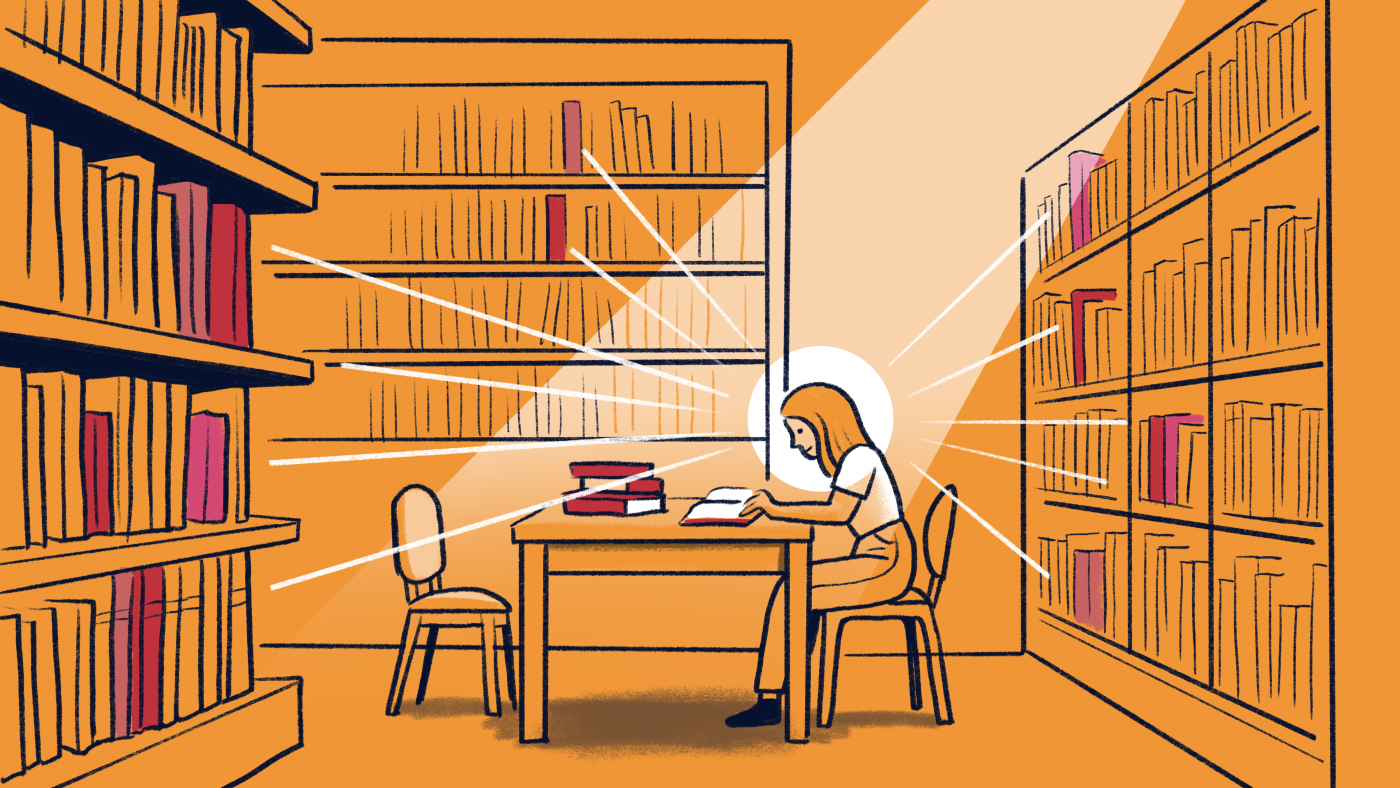
Shohamy: Yes, and I think our findings help explain why this happens. What we found is that learning something satisfying makes people more curious, but, specifically, about related information. So you read an article you enjoy, and that experience strengthens your interest in the topics next to it. You click a nearby link, it pays off again, and the cycle continues. That’s also why a rabbit hole has a certain direction. You don’t jump randomly from medieval history to cell biology; you follow a path, with each step shaped by the one before. We didn’t study Internet browsing directly, but the pattern people describe fits remarkably well with what we see in the lab.
I’d add that rabbit holes aren’t necessarily wasted time. In a sense, they’re your mind learning what it finds worth knowing
A satisfying first encounter could seed lasting interest, while an unsatisfying one could close a door.
What might your findings mean?
Shohamy: At the most basic level, they suggest that curiosity is not a fixed trait that we simply have or lack. It is shaped by experience. We know a great deal about how prediction and surprise drive learning in the brain, but most of that work has focused on tangible rewards like food or money. Our study treats information itself as a reward, and finds that curiosity seems to follow similar learning principles.
Abir: When you look at the scientific literature about curiosity, there have been two ways of thinking about how it works. The older, more established way argues that it's an irrational drive to seek out information regardless of its utility. In that scenario, curiosity's job is to keep us seeking a constant amount of novelty all the time, and it doesn't matter what the information we find is. In that model, satisfying your curiosity satiates it, for a time.
What we've shown is that's not true. Instead, we show that the experience of finding a satisfying answer to one question boosts one’s curiosity for subsequent related questions. This supports a recent model, which suggests that curiosity is our way of seeking information that may be useful for us in a complex world. Curiosity is how we learn where in the world we can find information that is interesting, useful and reliable.
Shohamy: That curiosity is learned in this way opens a bridge from basic brain mechanisms to some of the most important parts of human life, including our well-being, social lives, and education. A loss of interest in the world is one of the hallmarks of depression, so understanding how curiosity is sustained or eroded could eventually matter for mental health.
In terms of education, our findings suggest that early experiences with a subject may matter a great deal. A satisfying first encounter could seed lasting interest, while an unsatisfying one could close a door. And as more of our learning runs through AI tools, it raises an important question for future research: what kinds of answers nourish curiosity, and what kinds might satisfy the immediate question but leave us less inclined to keep exploring?
Why do you think researchers didn't discover this aspect of curiosity before?
Abir: Neuroscientists have this instinct that if we want to understand something, we should start with the simplest case possible. Let's study one discrete event after another, each independent of any other. However, we thought that approach was too simple for curiosity, because it unfolds over time—finding out one thing leads to another. Being able to make our discovery with a very simple experiment was very, very satisfying.
So is curiosity ultimately a way of learning how to learn?
Abir: I think that's the main function of curiosity — to teach us how to seek out information, because the world is so complex. We don't know what the next challenge we face is going to be, and we don't know what piece of information may help us solve that next challenge or not. So we have to be prepared. One way of being prepared is to know a lot of things, but that's not very efficient. A more efficient way of approaching an unknown challenge is knowing how to get the right information when you need it. Then you'll be able to better face life's challenges.
Shohamy: Part of what curiosity does is practical: it helps us find the information we need to make better decisions and meet new challenges. But our results suggest something more. That every time we satisfy our curiosity, we’re also learning something about curiosity itself, namely what kinds of information are worth seeking. So in a sense, curiosity teaches us what to be curious about. Over time, those small experiences may add up to shape our interests, and perhaps even who we become.