NEW YORK, NY — How do illusions arise in the brain? Can the brain help control inflammation throughout the body? How can AI help model and predict human behavior? Scientists across disciplines tackled these big questions and more at ZIFest, a neuroscience festival at Columbia's Zuckerman Institute last month.
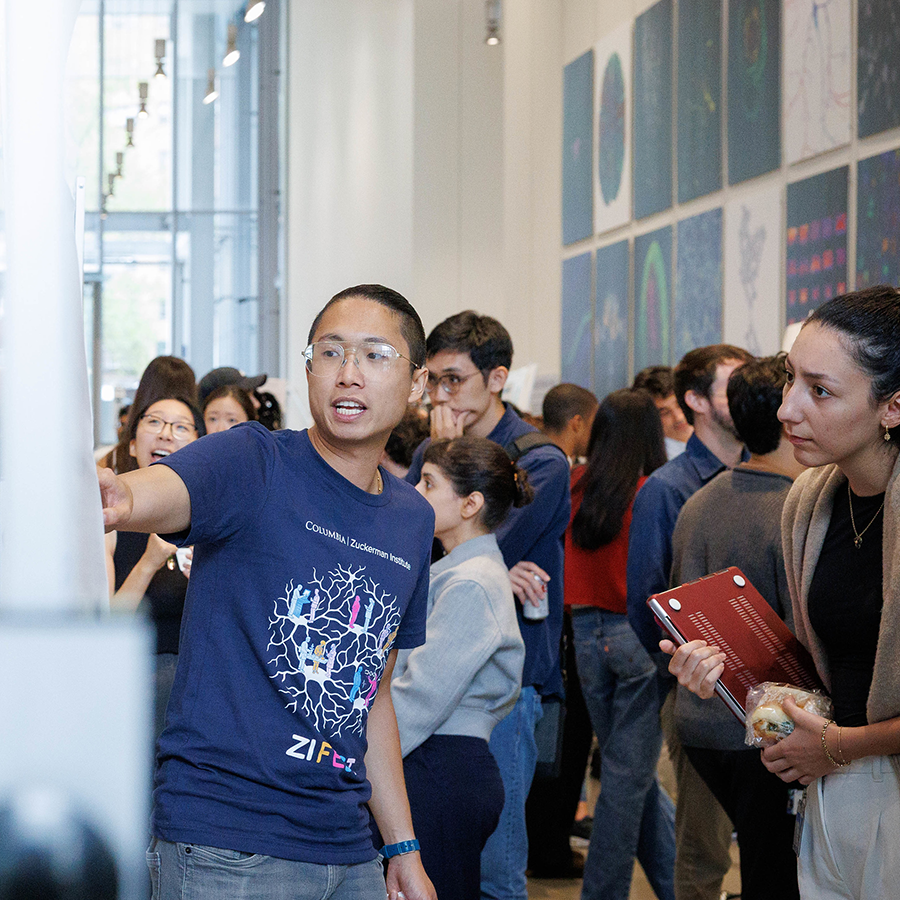
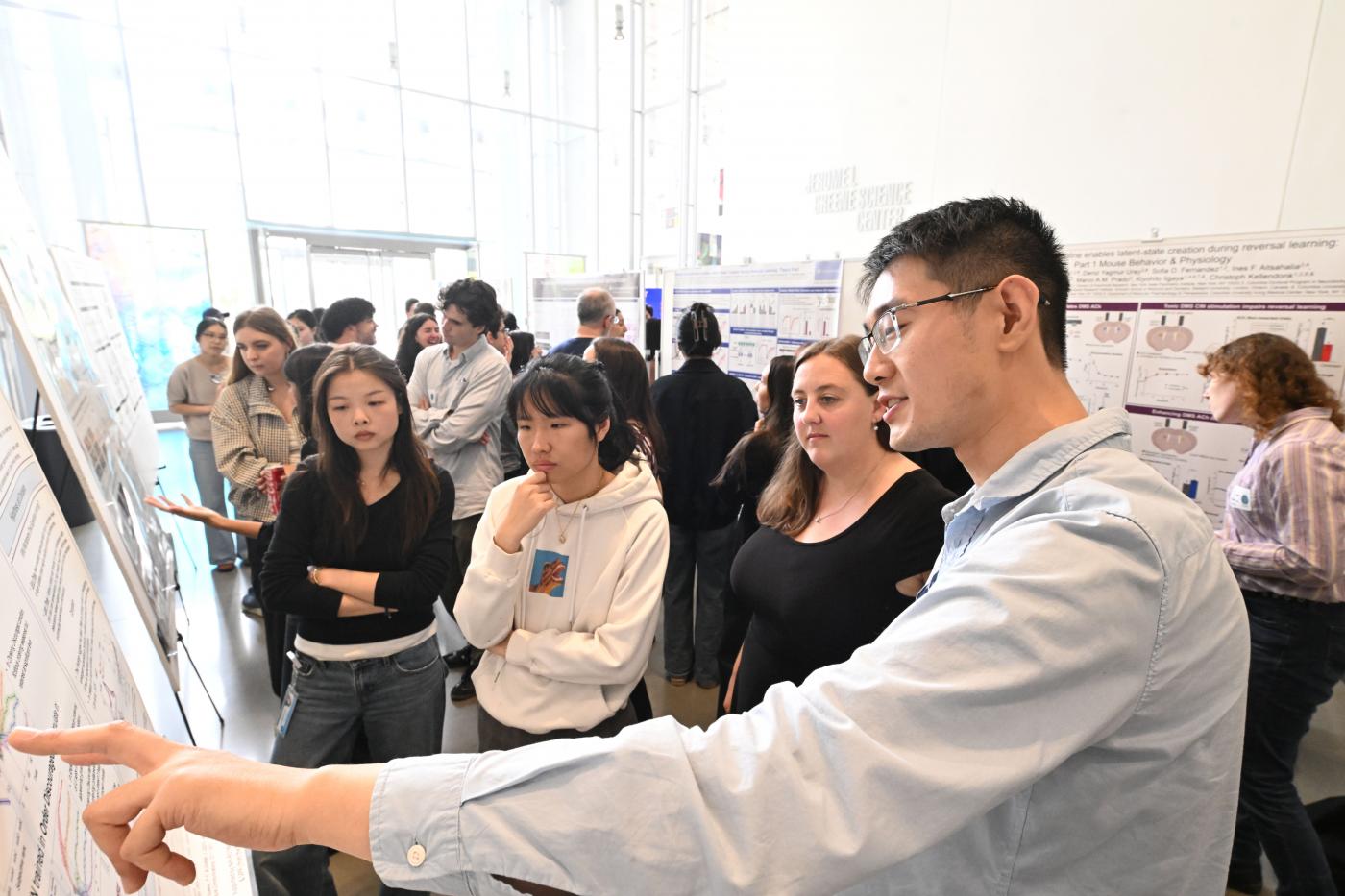
Faculty, postdocs and graduate students from across Columbia and the medical center gave 24 talks; researchers hosted nearly 30 science posters. Daphna Shohamy, PhD, director and CEO of Columbia's Zuckerman Institute, invited participants in the packed auditorium to learn “about work across many different labs and many different levels of analysis, from molecules to the mind,” in her opening remarks. “You’ll hear from faculty, students and postdocs, and have chances to ask people you’ve never met about their science,” she added.
Attendees learned about brain circuits that analyze the shape of objects, from assistant professor Yasmine El-Shamayleh, PhD; how the brain experiences pain during lung cancer, from associate professor Ishmail Abdus-Saboor, PhD; and how the brain handles sensations that differ from the norm, from senior scientist Darcy Peterka, PhD, among many others.
ZIFest attendees on the roof of the Greene Science Center (credit: Eileen Barroso).
A number of scientists detailed technological innovations as well. Neuroscientist Kim Stachenfeld, PhD, is using artificial intelligence to create programs that can accurately model and predict human and animal behavior. And professor Liam Paninski, PhD, is improving recordings of neural activity that AI can use to build models of behavior.
Neuroscience "has always been a combination of biology, physiology, engineering, computer science,” and more, “so by necessity, we find ourselves in a discipline that collaboration has kind of always been a part," said Gwyneth Card, PhD, chair of Columbia’s neuroscience department. "That's even more so as we progress with the technology that we use, and our domain knowledge gets deeper and deeper, and you end up with such a breadth of a field, with many different people with their own expertise," she added.
 Panel discussion with Drs. Daphna Shohamy, Rui Costa, Carol Mason and Gwyneth Card. (Credit: Eileen Barroso.)
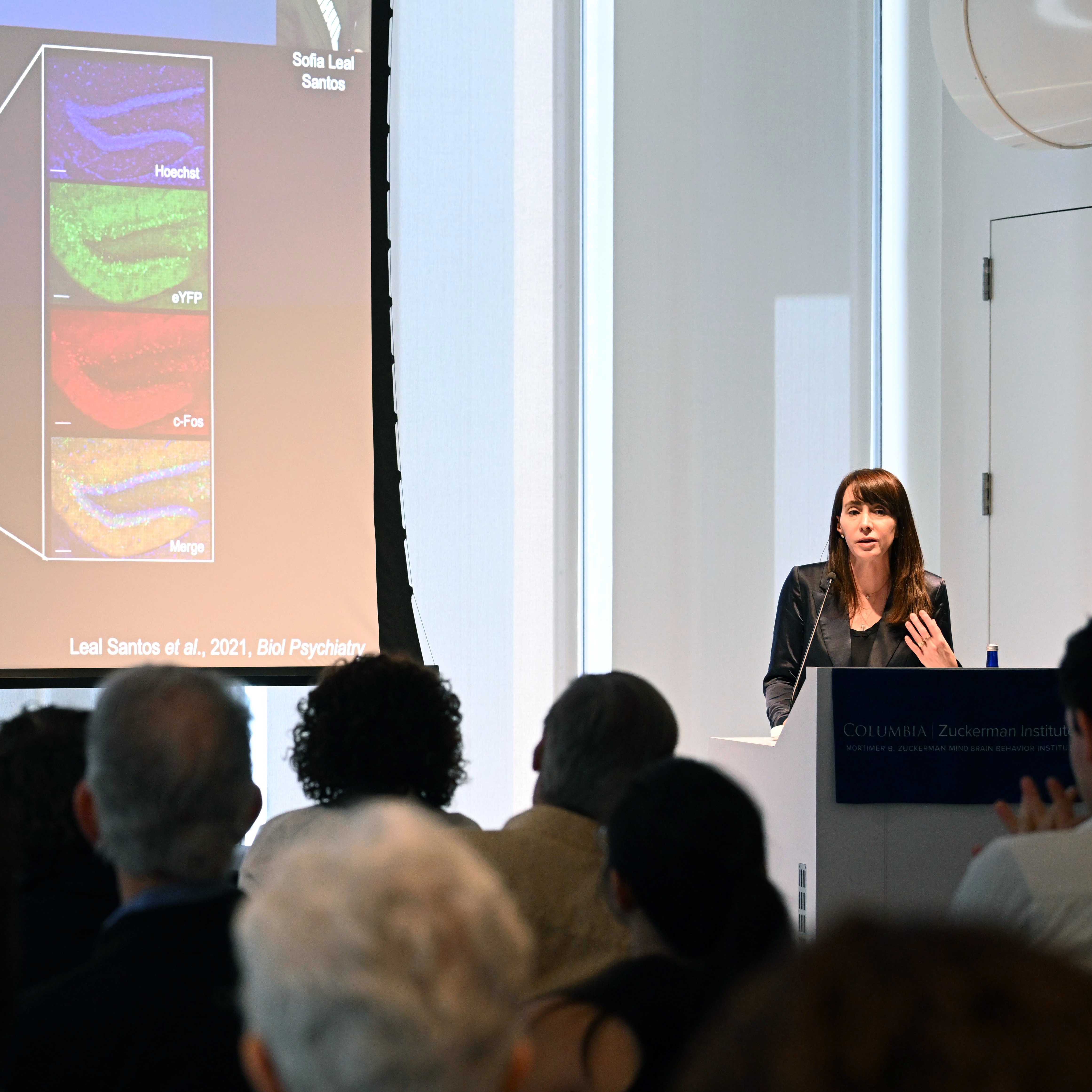
Computational neuroscientists also described their findings. Graduate student Abhishek Shah is examining how the brain compresses memories for storage. Professor Genevera Allen, PhD, is using statistics to help researchers see if apparent patterns in their data are real or not. Postdoctoral fellow Gal Vishne, PhD, is revealing how short-lived "iconic memories" become less precise over time.
And there was a special surprise halfway through the symposium: Charles Zuker, PhD, won this year’s Wolf Prize in Medicine for his groundbreaking research into perception, action and behavior, as viewed through the lens of taste. He immediately thanked his students and collaborators.
"Science, as you know, is a team effort, and so I take this time to acknowledge my past and present students, postdocs, research assistants, and staff that made this possible," Dr. Zuker said. "They are the heart of everything that we have done. So this prize and recognition goes to them."
ZIFest also showcased how early career scientists help drive discoveries. Postdoctoral scientist Thiago Arzua, PhD, is examining how the fear a mouse experiences can impact its offspring. And postdoctoral research scientist Xenia Gofman-Regev, PhD is exploring how the cerebellum helps control locomotion in mice.
All in all, for excellence in science, “it is so important to give people the freedom and confidence to be exploratory and drive discovery,” Dr. Shohamy said.