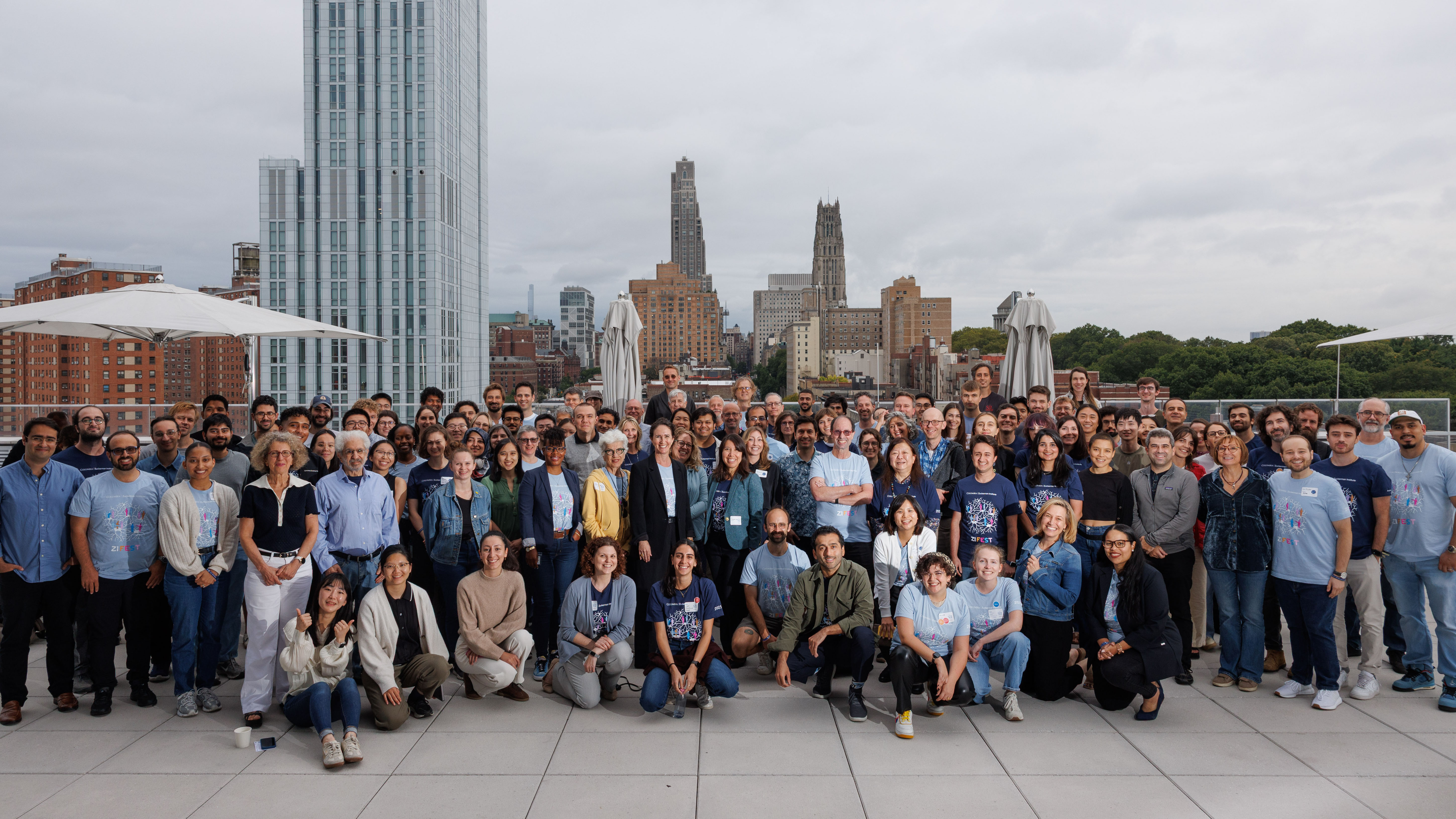
NEW YORK, NY — On its 20th anniversary, the Center for Theoretical Neuroscience at Columbia is a powerhouse like no other in the field, with a cadre of top-tier researchers and a uniquely collaborative culture. But even at its inception, the center stood out simply for hosting a pair of theoretical neuroscientists.
“When the field of theoretical neuroscience was young, it was a great breakthrough in the field to have two theoretical neuroscientists in one place,” said Ken Miller, PhD, who spoke about co-founding the center with Larry Abbott, PhD, at this year’s science festival at Columbia’s Zuckerman Institute.
“There was nothing like it then, and now the center has grown in a way we could have never imagined,” said Dr. Miller. The center now hosts nine principal investigators and roughly 80 affiliate faculty from across Columbia, postdoctoral researchers, graduate students and staff.
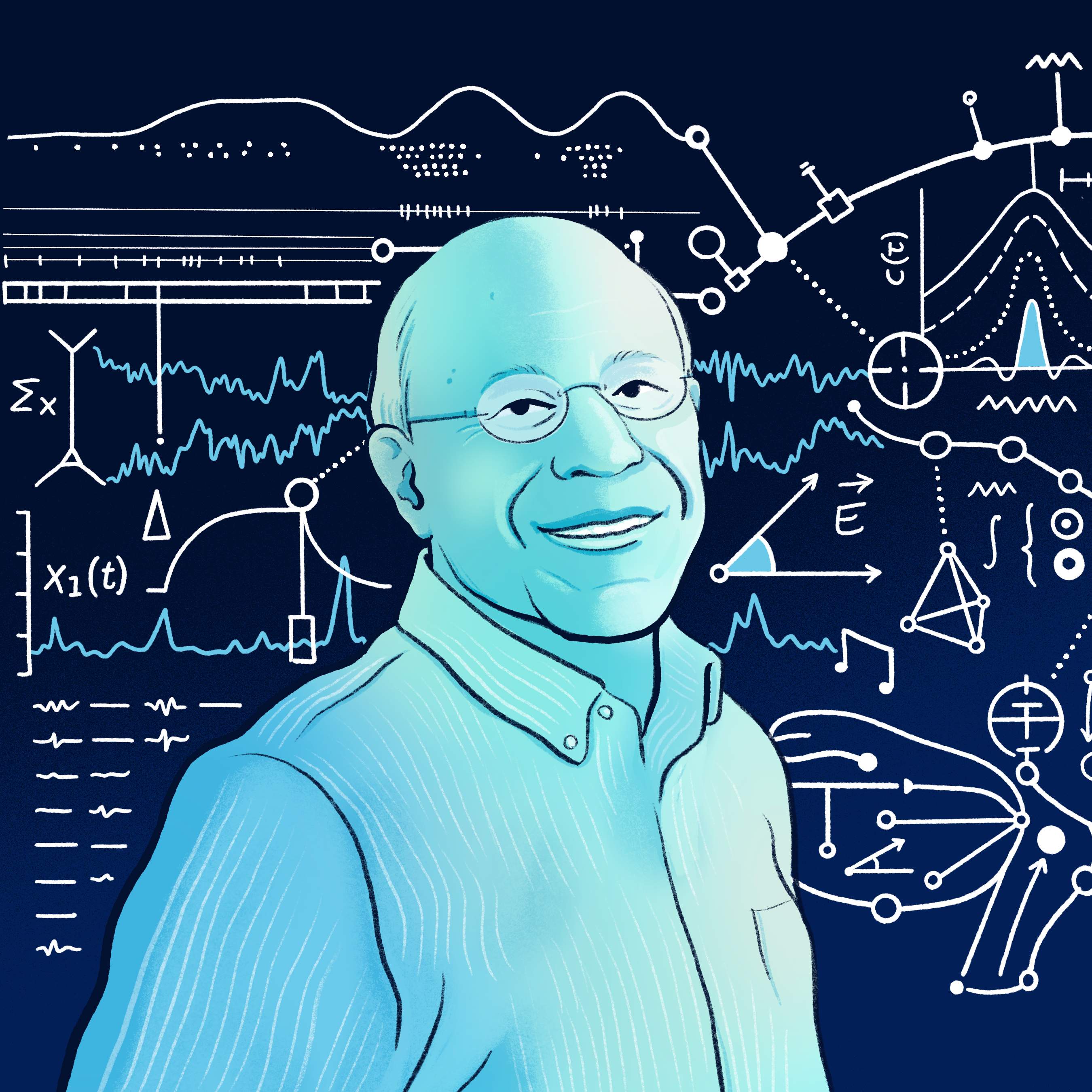
Theoretical neuroscience uses mathematical and computational tools to build models that yield insights on knowledge gathered from the brain and nervous system.
“Theoretical neuroscience is positioned to help us understand how to treat brain disorders and to understand the basic mystery of what it means to be human,” said Zuckerman Institute Director and CEO Daphna Shohamy, PhD.
Just as mechanical models of our solar system once helped astronomers predict the behavior of planets and moons, so too can the mathematical and computational models created by theorists help make sense of the brain.
“I believe nature speaks with mathematics, and if one wishes to analyze nature without mathematics, one will be left with a diminished understanding,” said Richard Axel, MD, codirector of Columbia’s Zuckerman Institute and a Nobel prize winner. “What modern neuroscience tells us is that this is indeed true.”
Advances in the techniques and tools used to measure and analyze the brain has led to an explosion of data in recent years, which has helped to dramatically expand the demand for theoretical neuroscientists who can make sense of these findings. “This group of scientists play a fundamental role in bringing all the other researchers here together, to help us make sense of our data, generate new hypotheses, and enhance the overall collaborative environment that makes this place what it is,” Dr. Shohamy said.
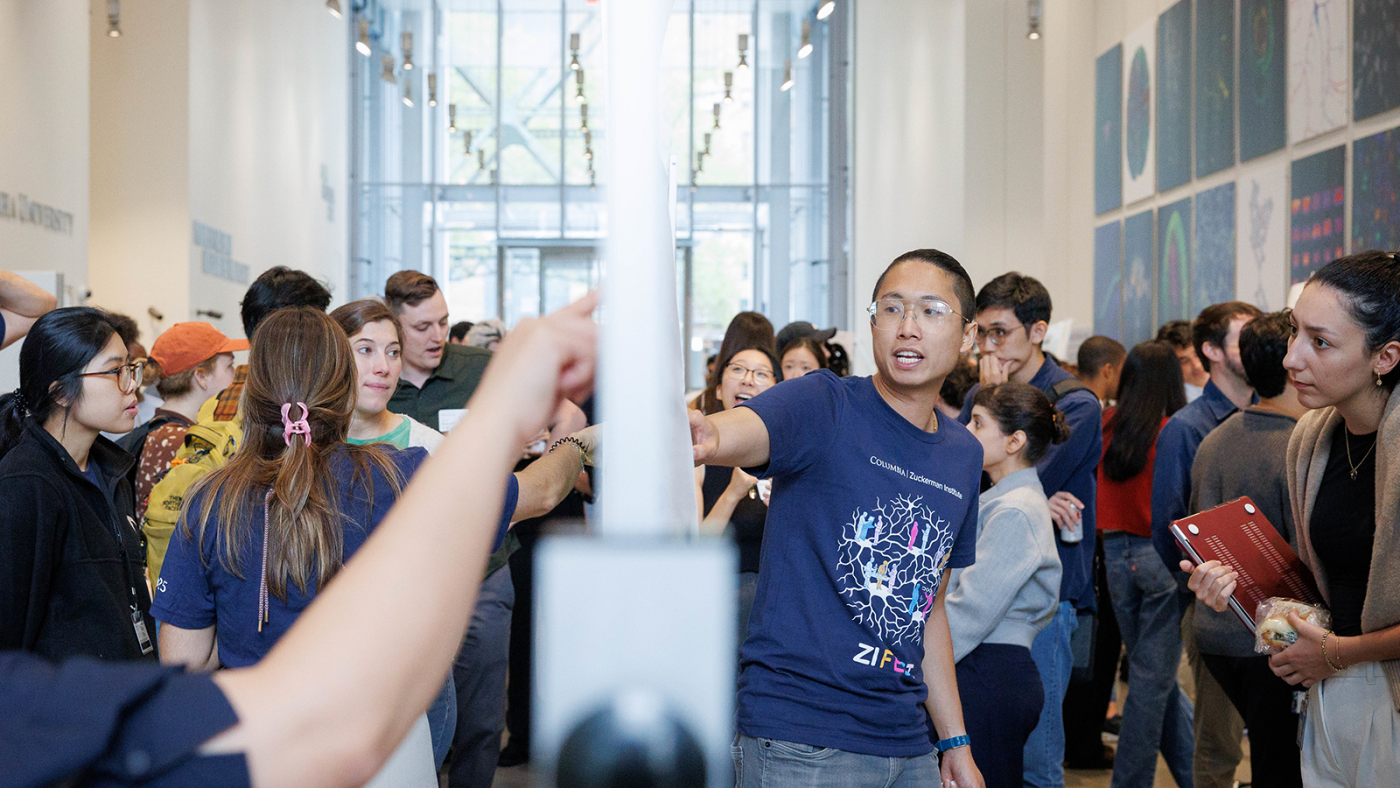
Instead of being siloed into labs, principal investigators, graduate students and postdocs work collectively on problems. The magic is in everyone talking with each other and contributing to each other's work in a supportive atmosphere, Dr. Miller said.
If you were to walk into the center, you would see people talking to each other, people writing equations on the walls all around you.
“The life of the place is immediately apparent,” added Dr. Abbott. “If you were to walk into the center, you would see people talking to each other, people writing equations on the walls all around you.”
Nathaniel Sawtell, PhD, a principal investigator at the Zuckerman Institute who studies the brain circuitry underlying our sensory capabilities, recalled how the center helped him make breakthroughs with his work. “I can bring my confusing data and my puzzles to some of the smartest people in the world, and they're going to help me figure it out,” he said. “That is really emboldening and makes you have the courage to do experiments and to dive in and get lost and be confused.”
The center’s reach now extends well past Columbia. “The trainees that we've graduated are now in universities all over the place,” Dr. Abbott said. “I hope they take our tradition of collaboration with them, and I hope they'll change the face of science, because theoretical techniques and ideas are critical to the future of neuroscience.”
Neuroscience is a field where researchers from very different backgrounds, from biology to physics to statistics and more, can help unravel the mysteries surrounding the brain. “In our work, if you have just a slightly different viewpoint on things, you can surprise each other and help make progress,” said Lea Duncker, PhD, a faculty member of the center and a principal investigator at the Zuckerman Institute. "Having these kinds of interactions is really helpful in a field as diverse as neuroscience, where it's not really clear what the background is to come in with."
At the end of the day, “the trainees learn enormously from each other,” Dr. Miller said. “These graduate students and postdocs have so much talent, they teach each other, and I've learned so much from them and the other faculty.”
All in all, “the brain is incredible — it's one of the most complex systems that we know of,” Dr. Duncker said. “Understanding how it works is such a hard problem, it never gets boring.”
Special thanks to the Kavli Foundation, Gatsby Foundation, and Simons Foundation for providing financial support for the Center for Theoretical Neuroscience. Dr. Shohamy and Dr. Abbott are codirectors of Columbia’s Kavli Institute for Brain Science. The faculty of the Center for Theoretical Neuroscience are also members of the Kavli Institute.