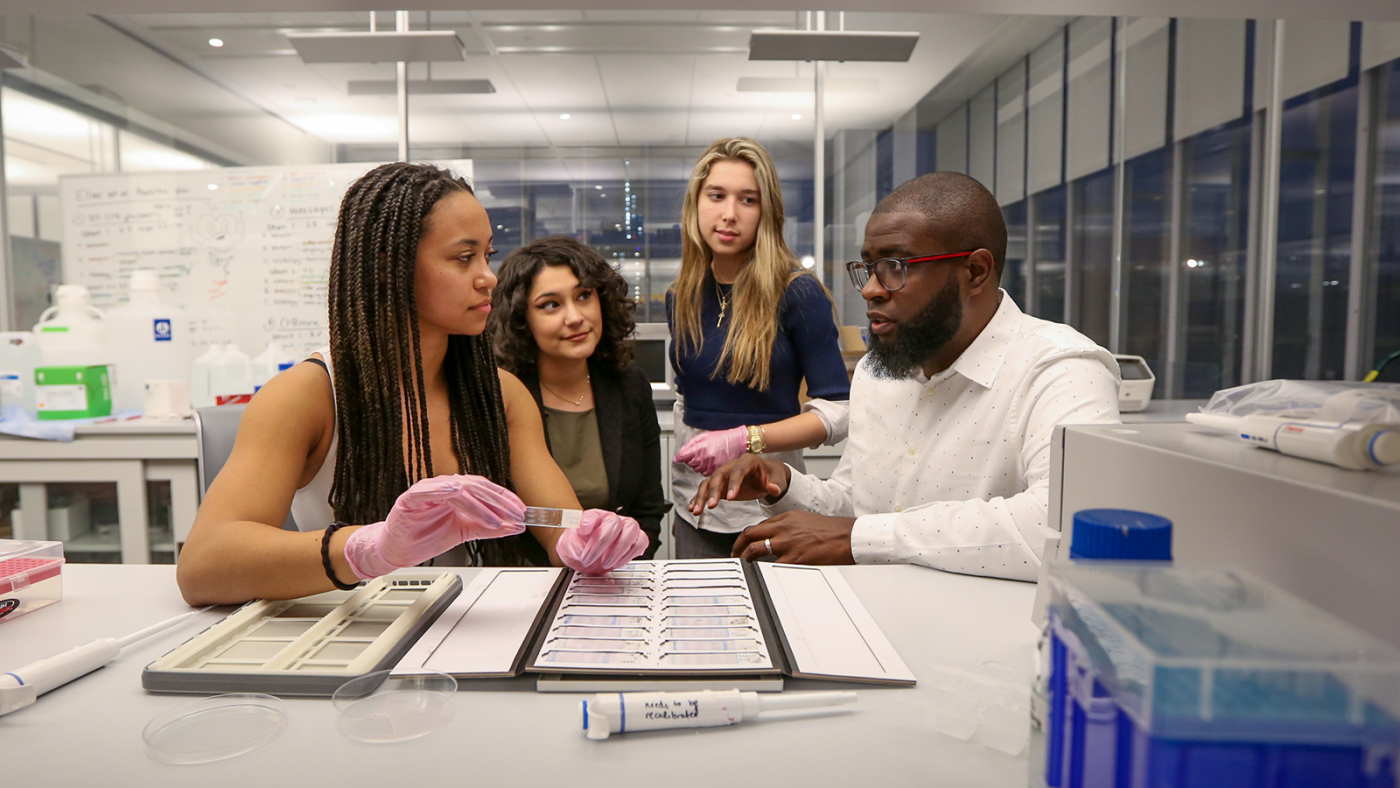
NEW YORK – Today, the National Institutes of Health (NIH) recognized Ishmail Abdus-Saboor, PhD, a principal investigator at Columbia's Zuckerman Institute, with this year’s NIH Director's Pioneer Award. The award supports outstanding scientists who propose creative, novel approaches to major scientific challenges. It will help fund research exploring the role the sense of touch plays in helping maintain harmonious relationships.
Dr. Abdus-Saboor, a neurobiologist and expert on the sense of touch, will receive $5.75 million over the course of five years for use in bold research projects with potentially unusually broad scientific impacts. Established in 2004, the award is part of the NIH Common Fund's High-Risk, High-Reward Research program, which was created to support exceptionally creative scientists conducting highly innovative biomedical, behavioral and social science research.
“We’re exploring how the sense of touch can be used to drive communication, social memories and even cooperation,” said Dr. Abdus-Saboor, an associate professor of biological sciences at Columbia University.
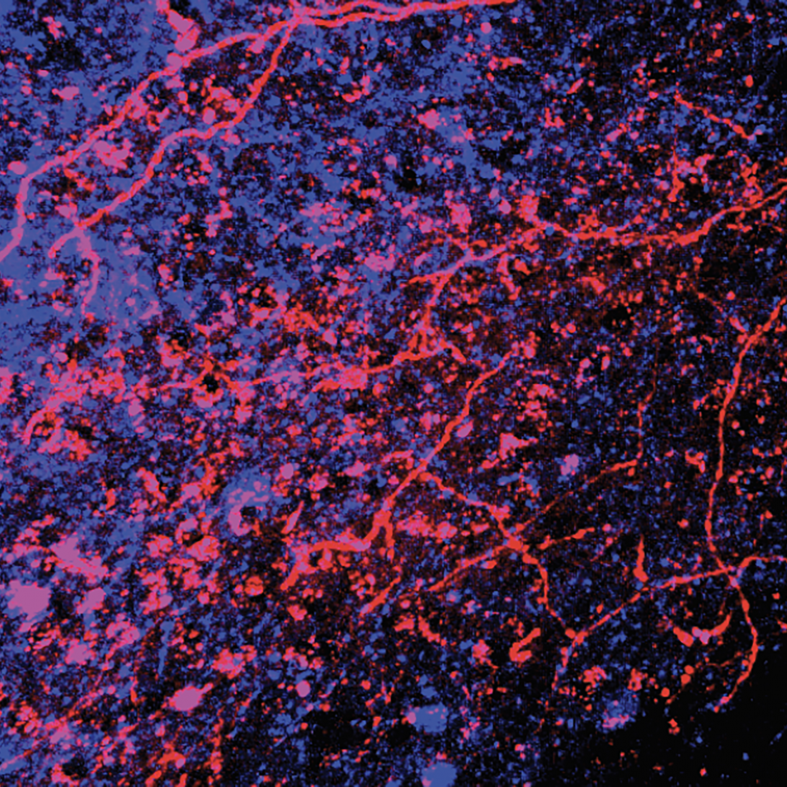
Dr. Abdus-Saboor will use his Pioneer Award to explore the brain circuitry that helps the East African naked-mole rat maintain long-term relationships. These blind rodents live underground in complete darkness, maintaining tightly knit societies of dozens to hundreds of the animals in a single colony over decades, reminiscent of the stable relationships seen in human societies.
Naked mole rats are covered in roughly 100 hair-like whiskers that are far more sensitive than the hairs of most mammals, and the part of their brain devoted to touch is three times larger than seen in other mammals. Dr. Abdus-Saboor speculates that the naked mole-rat's heightened capacity for touch helps them identify others. Determining how animals recognize and remember members of their own groups to cooperate to solve tasks is a fundamental question in neurobiology, and solving this problem in naked mole rats could yield insights into human relationships.
These kinds of communal behaviors are some of the first to diminish in nervous system conditions such as autism, schizophrenia, major depression, chronic pain and chronic stress. Uncovering the genes, molecules and neural circuits that underlie these behaviors may one day help researchers to develop treatments for restoring these vital aspects of ourselves.
Previously, in 2023, Dr. Abdus-Saboor became a member of the inaugural cohort of the prestigious Howard Hughes Medical Institute's Freeman Hrabowski Scholars program. He was also named a McKnight Scholar for research excellence and inclusion in the lab. In 2022, he won the prestigious NIH Director's HEAL Initiative New Innovator Award (DP2) for work to research pain sensitivity and new potential pain targets.