NEW YORK, NY — Is forgetting useful? Brain scientists from across Columbia and its medical campus took opposing sides when answering this question at a conference packed with students, professors, trainees and colleagues. Their resulting dialogue highlighted just how much we have to learn about memory, neuroscience and AI.
Forgetting is essential, said Scott Small, MD, a neurologist who described a patient with an extraordinary memory who could not encounter a glass of wine without being overwhelmed by everything they remembered about the experience: from the day the grapes were harvested to every cloud in the sky.
"That kind of total recall is a nightmare," said Dr. Small, director of the Alzheimer’s Disease Research Center at Columbia's Irving Medical Center and a professor of neurology. "Because every time, every day, these people have this complete flood of memories, and they just can't function."
Stefano Fusi, PhD, who builds mathematical models of brains, and Kim Stachenfeld, PhD, who researches memory in both biological and artificial intelligence, held a different view — that forgetting may not be needed.
"I'm not sure you can make the statement that forgetting is necessary," said Dr. Fusi, a theoretical neuroscientist at Columbia’s Zuckerman Institute. "I don't think I would design a system that has to forget to solve particular problems. I would rather design a system that controls how to read memories.”
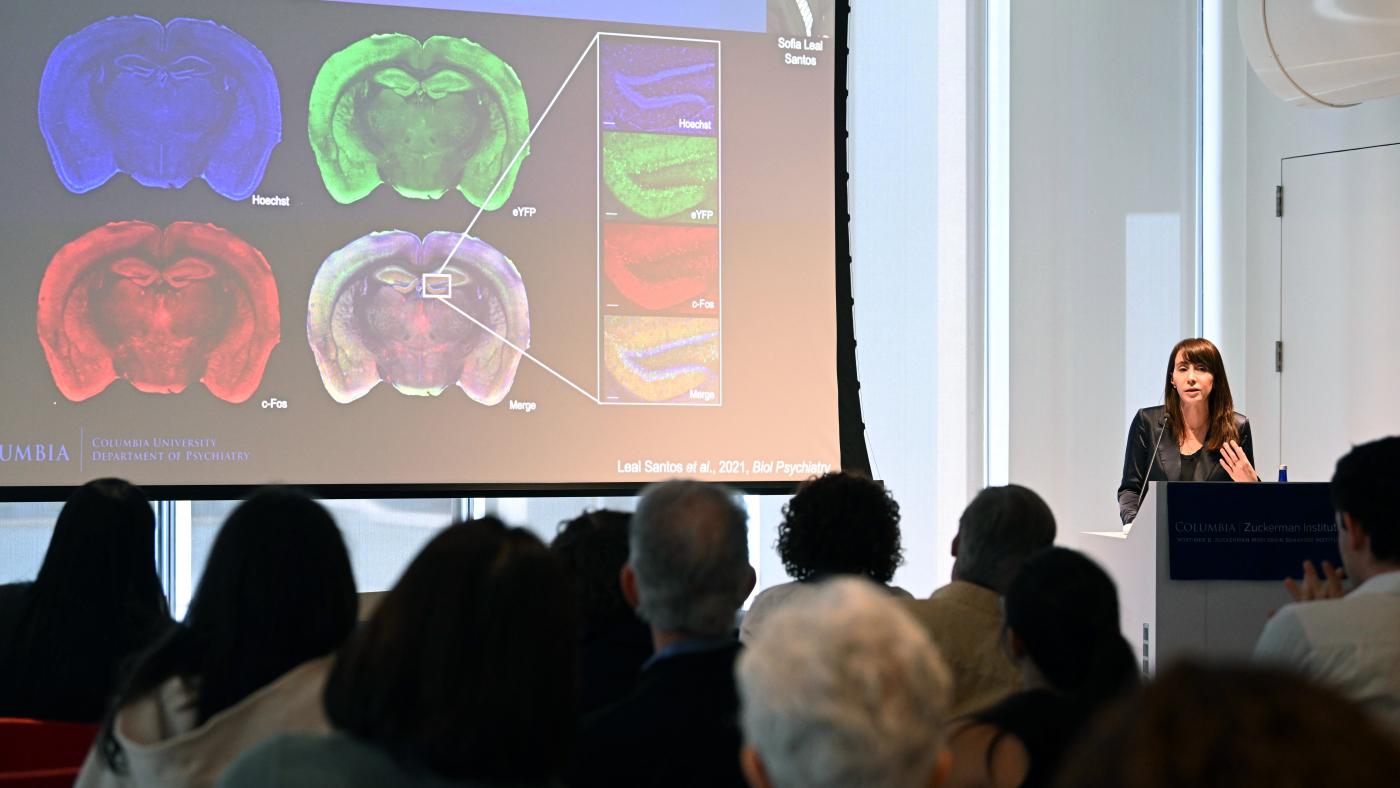
The debate proved fitting at the event on May 12 to inaugurate the Zuckerman Institute’s new Alan Kanzer Center for Cognition and Reasoning. This research pillar will support cutting-edge science and promote interdisciplinary collaboration and dialogue, all to better understand how we learn, think, reason, remember and make sense of the world.
The new center will tackle interdisciplinary questions at the forefront of what it means to be human
"The new center will tackle interdisciplinary questions at the forefront of what it means to be human," said Daphna Shohamy, PhD, director of Columbia’s Zuckerman Institute.
“Memory has long been studied as a question about the brain and mind, in biological systems, but it turns out that it has become one of the most pressing questions in artificial intelligence as well,” said Dr. Shohamy. “This convergence is creating a rare opportunity for neuroscience and engineering to learn from each other. Engineers and neuroscientists are now grappling with similar questions: how to build memory that is selective, flexible and useful?”
The Kanzer Center was established to drive advances in understanding the mechanisms of thought and mental processes. Building on the university’s leadership in neuroscience, the new research initiative was made possible thanks to the generous donation of Alan Kanzer, a Columbia College alumnus, class of 1965, and a longtime supporter of the Zuckerman Institute.
The symposium explored how memories are formed, structured and used to guide behavior in both biological and artificial systems. It drew a full house of undergraduates, graduate students, trainees and professors from across Columbia, from diverse disciplines including neurology, computer science, neurobiology, psychology and neuroscience, to name a few.
"The contrast between artificial intelligence and the human brain can help us better understand both how our minds work and how these new technologies will shape the future," said Angela V. Olinto, PhD, Provost of Columbia University and Rutherfurd Professor of Astronomy and Professor of Physics, in her opening remarks.
"The idea of the symposium today is to tackle a question that no one person in no one lab and no one school or institute can tackle, but an area where there's remarkable expertise across the university as a whole," added Dr. Shohamy, who is also a Kavli professor of brain science and co-director of Columbia’s Kavli Institute for Brain Science.

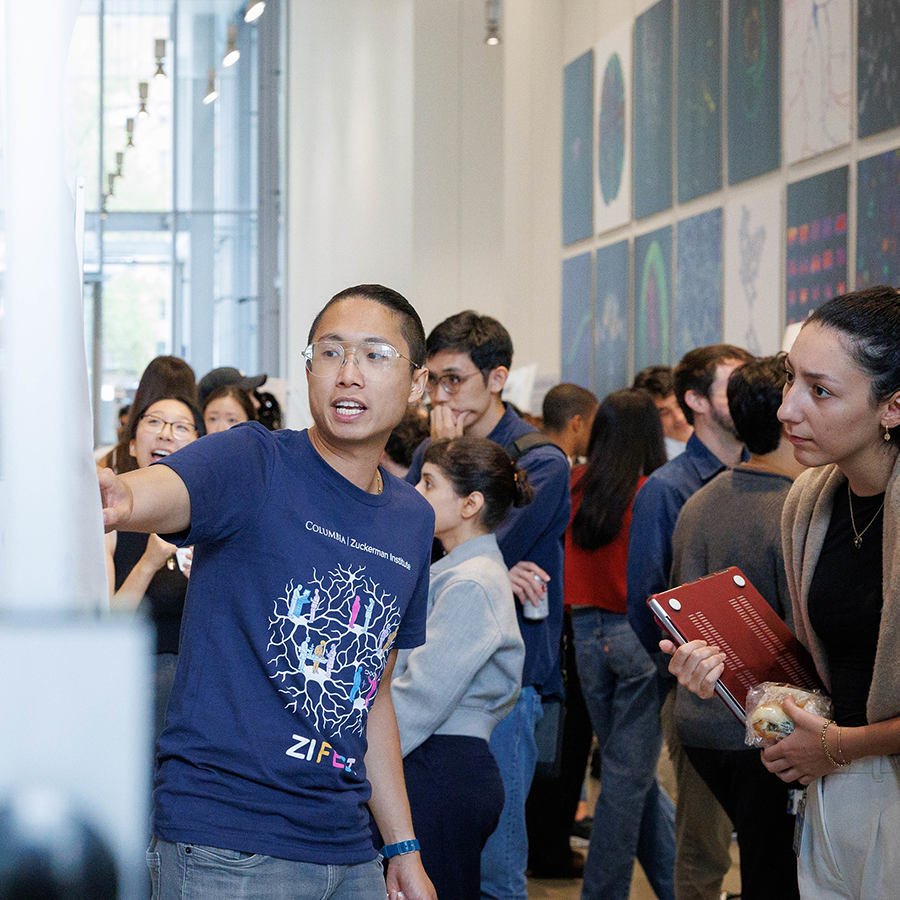
Audience members quizzed Columbia researchers about the nature of memory. Credit: Eileen Barroso.
Richard Zemel, PhD, director of Columbia’s AI Institute for Artificial and Natural Intelligence, supported by the National Science Foundation, discussed research into helping AI continually learn new tasks and adapt to new environments without completely forgetting what it previously learned.
Dr. Fusi, a member of Zuckerman’s Center for Theoretical Neuroscience, recalled how nearly 30 years ago, when he entered neuroscience, researchers really thought they had understood how the brain stores memories. When he said he recently asked Google's AI assistant Gemini to generate an image of the consequences of this early model when realistic synapses were considered, he drew laughs when he showed a picture of the world ending. "It's really catastrophic, because it's an extremely inefficient system," recalled Dr. Fusi, also a professor of neuroscience at Columbia’s Vagelos College of Physicians and Surgeons.
Now, with more complex models of how the brain encodes memory, Dr. Fusi said neuroscience had better insights into how the brain can both encode memories and not immediately forget them. "I encourage Daphna to organize another workshop in 30 years to see whether we were right or not," Dr. Fusi said, enticing more laughs.
The audience also heard from Dr. Stachenfeld, a senior research scientist at Google DeepMind, and an adjunct assistant professor of neuroscience at Columbia, on how brains and AI models can infer relationships among indirectly related items, and Chris Baldassano, PhD, associate professor of psychology at Columbia, on how richly detailed experiences can behave as maps that help store later memories for improved recall.

(Left to right) Kim Stachenfeld, PhD, Stefano Fusi, PhD, and Chris Baldassano, PhD, discussing the nature of forgetting. Credit: Eileen Barroso.
A highlight of the symposium was presentations from graduate students and postdoctoral researchers. These included how to train artificial intelligence models to sequentially learn multiple tasks, from Minni Sun, PhD; how brain cell activity akin to barcodes can help birds known as black-capped chickadees remember where they hid morsels of food, from Selmaan Chettih, PhD; how AI models can predict what data they might receive and only focus on surprising information to perform more efficiently, by PhD student Todd Morrill; and how AI can analyze the diaries of volunteers and learn about what events they remembered best and why, by PhD student Erin Welch.
At the end of the day, everyone agreed on the critical importance of understanding memory not just for treating disease and improving AI, but for understanding ourselves.
“We are our memories,” said Christine Denny, PhD, an associate professor of clinical neurobiology at Columbia’s Irving Medical Center, who researches the molecular mechanisms underlying learning and memory. “Memories define us.”