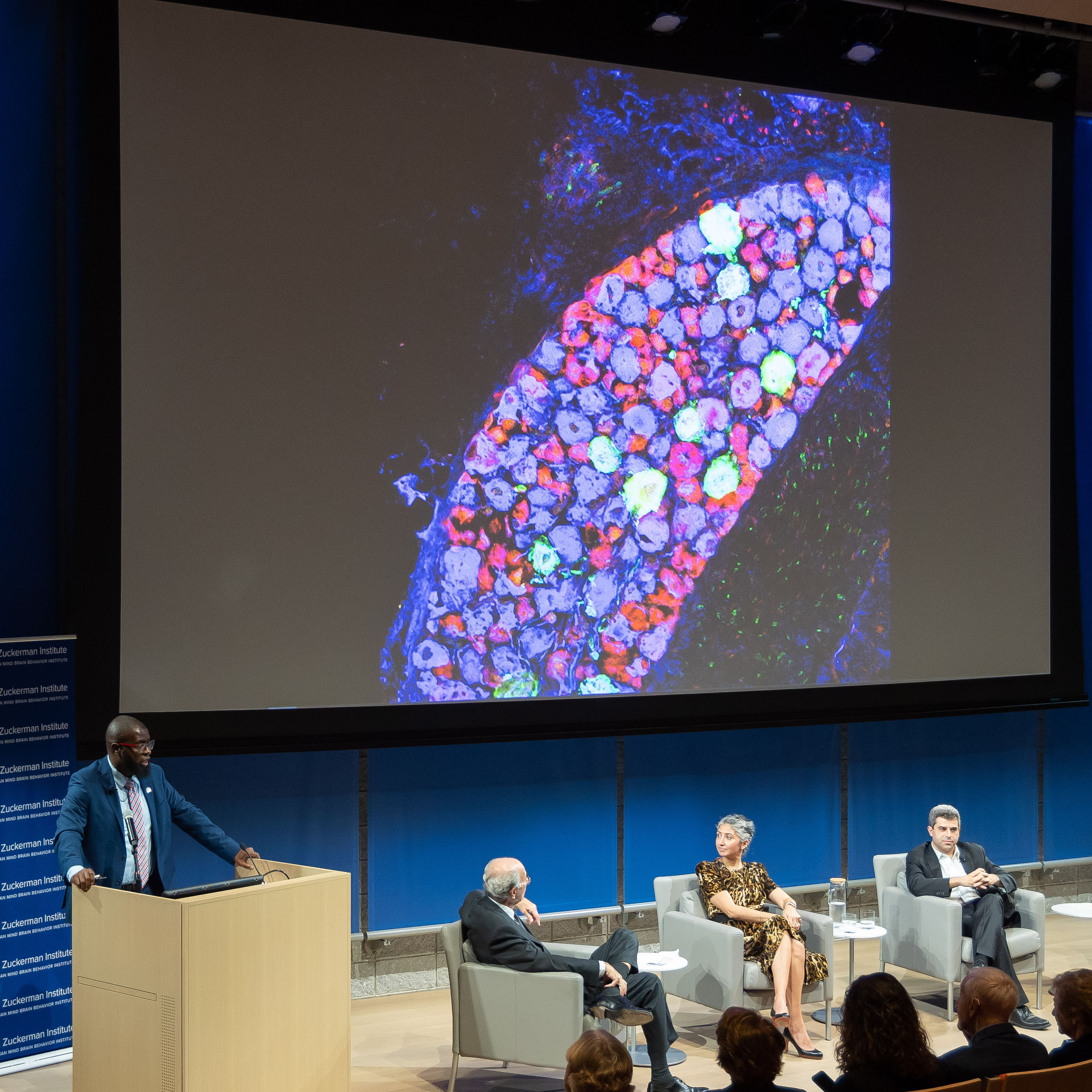
NEW YORK, NY — When doctoral student Elizabeth Wasserlein of the Yamamoto lab began discussing TDP-43, a protein linked to neurodegenerative disorders, many in the audience at ZIFest already knew its name. Not because it's famous, but because a row of supporters in TDP-43 t-shirts were cheering in the back. This scientific hype squad, as Wasserlein called them, came from her lab to attend her talk before an audience of neuroscientists studying everything from artificial intelligence to zebra finch songs.

Elizabeth Wasserlein presenting. (Credit: Sirin Samman)
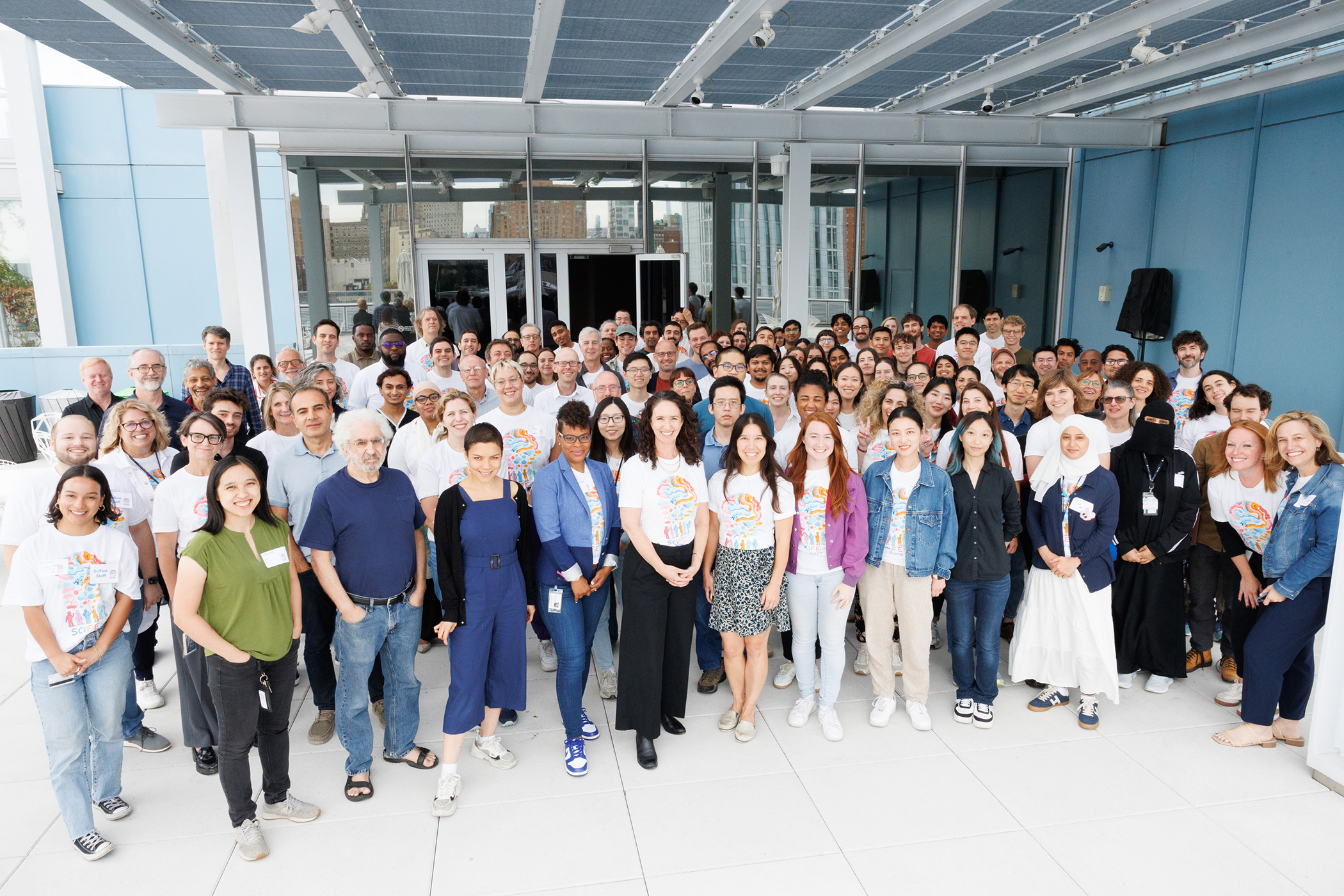
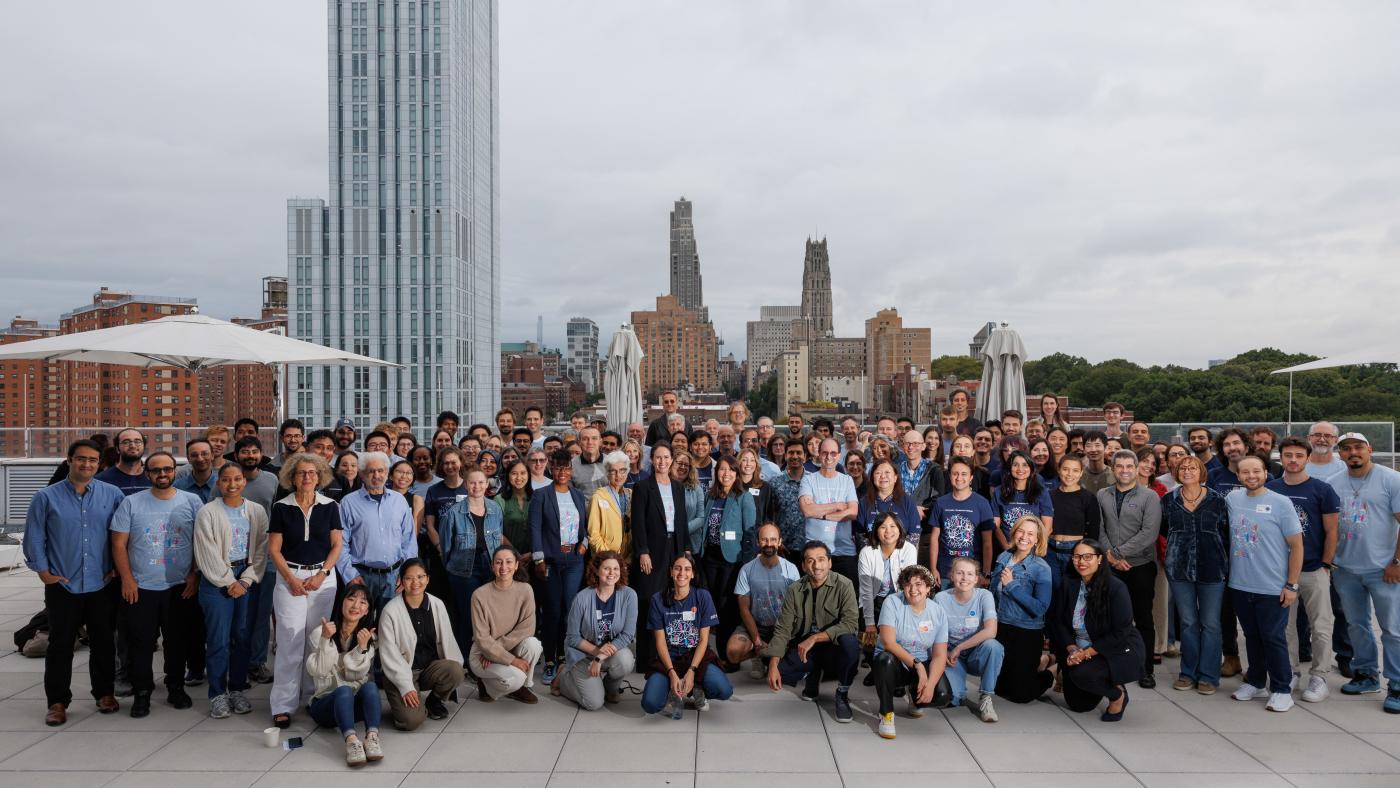
This enthusiasm defined ZIFest 2025, a two-day neuroscience celebration at Columbia's Zuckerman Institute in mid-September. Attendees heard 26 talks and data blitzes by faculty, graduate students and postdocs from across Columbia and browsed dozens of science posters in the Greene Science Center, the institute’s home.
Presentations included how the brain decides what to learn from Jacqueline Gottlieb, PhD; how recognizing emotions helps humans and AI to recognize faces, from Elias Issa, PhD; how the brain controls movement from Daniel Wolpert, PhD; and how fruit flies use color and orientation to navigate, from Rudy Behnia, PhD.

Poster presentations at ZIFest (Credit: Sirin Samman)
"One of the secret sauces of this building is actually all of our differences," said Gwyneth Card, PhD, the new chair of Columbia’s neuroscience department, who also presented about how flies avoid danger. Speaking to an audience of researchers from the institute and the university, she found common ground in their varied and diverse interests. "We're united, perhaps, in our quest to understand the brain and the mind. And I love this event as a chance to celebrate the progress we've made together and hopefully birth new conversations, new ideas and new collaborations."
The people presenting science spanned generations. Theorists Ken Miller, PhD, and Larry Abbott, PhD, who have worked at Columbia for some 20 years, presented alongside trainees. Graduate student Rachel Estrella from Dr. Behnia’s lab described how the color of light might influence the body clock of fruit flies. Postdoctoral researcher Salomon Muller, PhD, discussed how the brain suppresses signals from predictable sounds.
Some researchers jovially tied their talks to the Zuckerman community. While speaking about learning from experience, doctoral student Chris Iyer of the Shohamy lab quipped that "your decision to come to ZIFest today, for many of us, was based on a single episode from last year." Andrés Bendesky, MD, PhD, discussed the oldfield mouse, which might owe its devoted parenting behavior to a unique hormone-generating brain structure: the zona inaudita, "aptly nicknamed the ZI layer," he said.
 Audience at ZIFest (Credit: Sirin Samman)
This year's ZIFest also celebrated the 20th anniversary of Columbia’s Center for Theoretical Neuroscience (CTN). To honor it, rather than presenting their own work, scientists from CTN playfully presented their colleagues’ “greatest hits.” Ashok Litwin-Kumar, PhD, described Dr. Miller’s findings on how excitatory and inhibitory neurons interact. Lea Duncker, PhD, summarized models of flexible neural computation created by Stefano Fusi, PhD. Dr. Miller revisited Dr. Abbott and Dr. Fusi’s studies on making new memories without overwriting old ones. And Genevera Allen, PhD, explored how the lab of Liam Paninski, PhD, helped develop tools to track behaviors, such as fruit fly leg motions and fish swimming, and analyze signals from thousands of neurons at once.

Larry Abbott and Ken Miller, interviewed by Daphna Shohamy. (Credit: Sirin Samman)
Institute Director and CEO Daphna Shohamy, PhD, reflected on recent challenges to science funding. She asked, “What are we fighting for and what are we doing here?" Her answer: ZIFest. "We're celebrating discovery, we're celebrating knowledge, and we're celebrating what it means to look out for one another and to ask each other questions and to engage in open inquiry that changes how we think."
 TDP-43 team members (Credit: Sirin Samman).