Art in the Education Lab
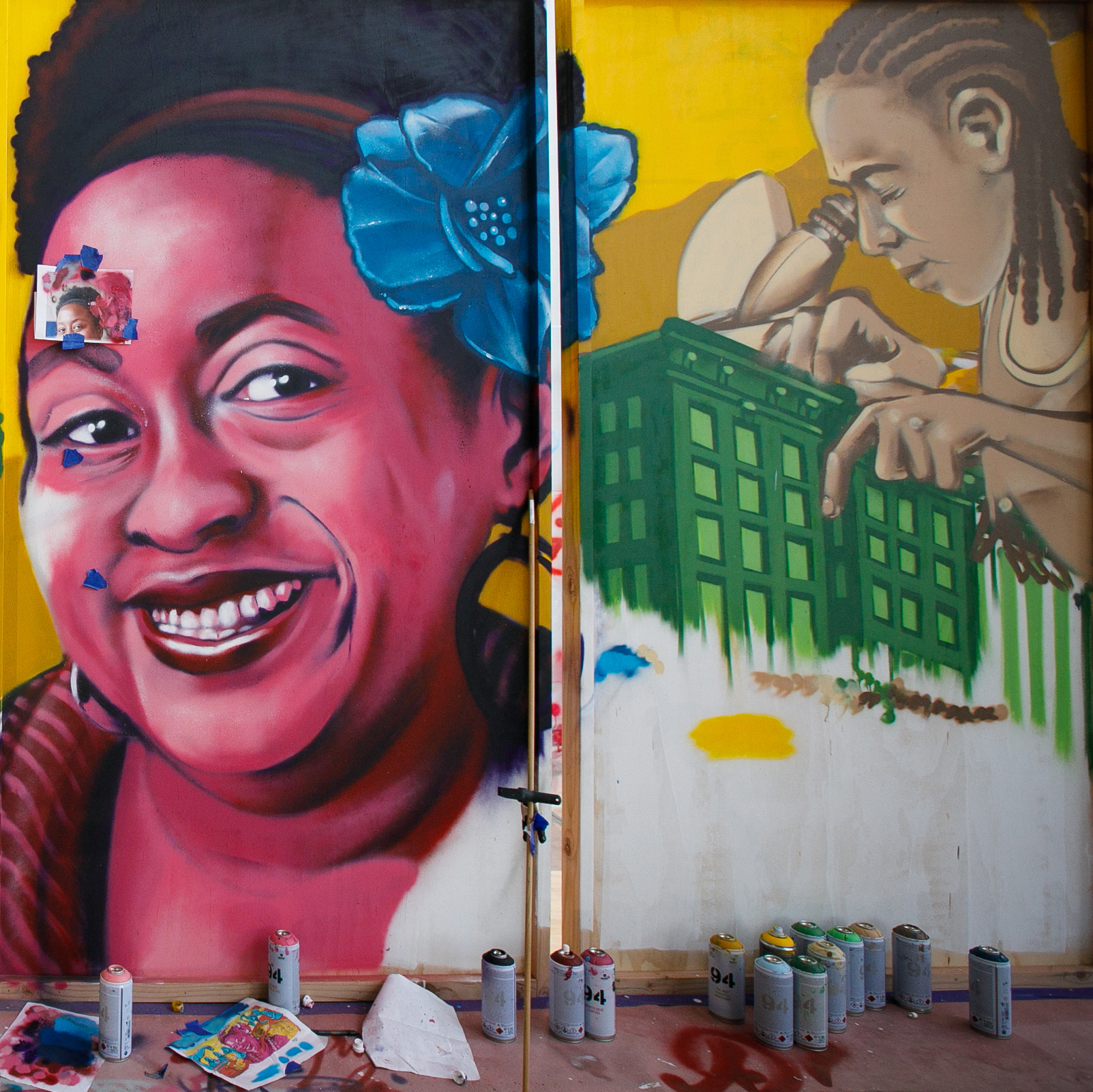
Every year the Zuckerman Institute commissions an artist to create an original artwork that will invite and inspire community members to explore science through an artistic lens.
The Shape of Memory
What is the physical form of a memory?
To explore this question, artist Maya Ciarrocchi has created a woven Jacquard tapestry, inspired by conversations with researchers at ZI. She was particularly intrigued by the work being done in the Dmitriy Aronov Lab, where scientists study the black-capped chickadee—a tiny bird known for its incredible ability to hide thousands of bits of food and remember exactly where it put them.
The artwork is based on real data, including maps of where the birds hide and retrieve their food, a behavior known as “caching”. Maya found inspiration in the distinctive patterns associated with their memory formation. By turning this scientific information into a physical fabric, the project helps us "see" the invisible process of thinking. It’s a reminder that memory isn't just a biological trick; it’s also a deeply personal experience connected to the spaces we move through and the things we touch.

Dr. Sandra Romero Pinto explains some of the imagery from research that inspired the artist. Photo credit: Sirin Samman
Maya Ciarrocchi is a Canadian American interdisciplinary artist living and working in the Bronx, NY. Her work emerges from a background in dance, choreography, and theatrical design, disciplines where movement, image, and space are inherently connected.

Maya drew inspiration from numerous conversations with Zuckerman researchers.
Much of the inspiration for The Shape of Memory came from the artist’s interactions with scientists at the Zuckerman Institute, including Dr. Benita Jin of the Stavros Niarchos Foundation Center for Precision Psychiatry & Mental Health; Zach Mayer of the Bendesky Lab; Dr. Sandra Romero Pinto of the Aronov Lab; Dr. Alexis Stutzman of the Marlin Lab; and principal investigators Dr. Andrés Bendesky and Dr. Tommy Vaughan.
This latest commission of Art in the Education Lab was unveiled in June of 2026 and can be seen through the windows of the lab near the entrance to the Jerome L. Greene Science Center at 605 West 129th Street.

Community members gathered in the Education Lab on June 18 for the unveiling of The Shape of Memory. Photo credit: Sirin Samman
Maya Ciarrocchi’s work advances the mission of the Zuckerman Institute to help make science more accessible and interdisciplinary by breaking out from the expectations of traditional scientific programming.
***
Learn about our work with previous Artists in the Education Lab: Ezra Wube (2025), Sleepyfoot? (2024), Damali Abrams (2023), Dister Rondon (2021), and Ivan Forde (2020).
To get involved, tell us your ideas, or find out more, email us at programs@zi.columbia.edu.
CALL FOR ARTISTS 2027 will be announced in December 2026